The interior decoration market is undergoing a rapid transformation. Between the tightening European regulations on the eco-design of products and the massive return of raw materials into interiors, the decor choices of 2026 are no longer just a matter of taste. They also involve a reflection on sustainability, traceability, and the coherence of living spaces.
Digital passport and eco-design: what changes for decorative furniture
The European regulation ESPR (EU 2024/1781), which came into effect on July 18, 2024, mandates mandatory eco-design for almost all physical goods sold in the EU, including furniture and decorative objects. A work plan adopted on April 16, 2025, by the European Commission outlines specific delegated acts for furniture and mattresses before 2030.
The most visible consequence for consumers will be the product digital passport, accessible via QR code. This document will detail the composition, carbon footprint, reparability, and recycling pathways of each piece of furniture or accessory. The European register of digital passports is expected to be operational by July 19, 2026.
At the same time, as of that date, large companies are no longer allowed to destroy unsold new clothing and shoes. This logic foreshadows similar pressure on unsold furniture and decoration as the delegated acts are rolled out. For those looking to furnish or redecorate, browsing the home selection on Niddou allows for spotting accessories whose traceability and composition are documented.
In France, the AGEC law (2020) strengthens this framework through extended producer responsibility (EPR) for furniture and decorative objects. In practical terms, manufacturers and distributors finance the collection and recycling at the end of life, gradually steering the supply towards more sustainable products.
Raw textures and soothing colors: materials redefining the living room
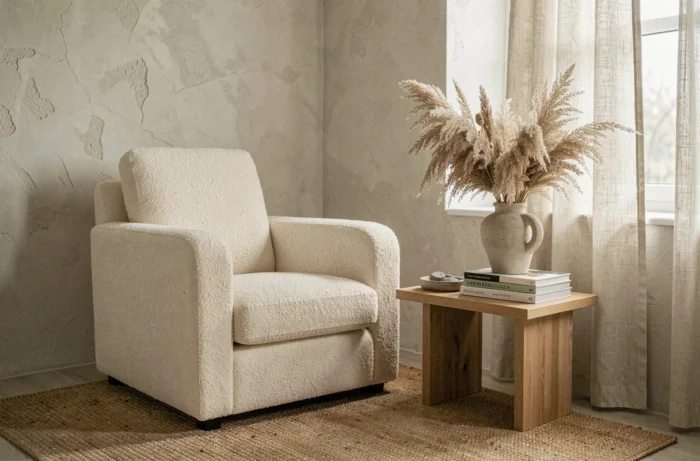
The decor trends of 2026 mark a clear shift towards natural textures and organic shades. Cold minimalism is giving way to more tactile interiors, where raw wood, stone, linen, and terracotta coexist.
The dominant colors are anchored in a soothing palette. Greige (gray-beige) tones, soft ochres, and muted greens replace the clinical whites that have dominated interiors for several years. This evolution reflects a search for visual well-being in everyday living spaces.
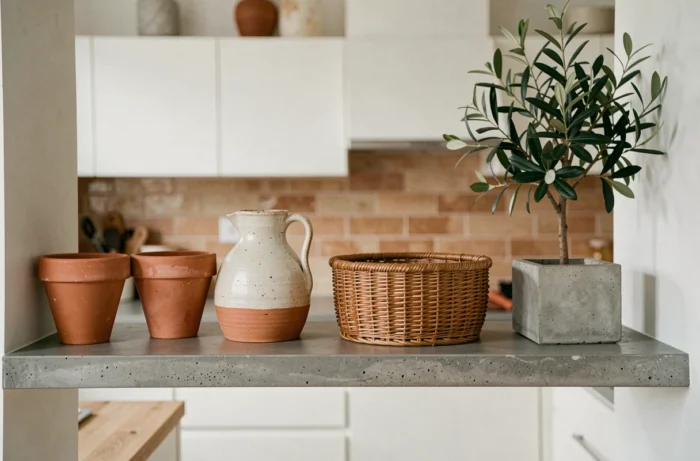
- Unfinished raw wood, used for tabletops or wall shelves, brings immediate warmth without overwhelming the room.
- Natural stone (travertine, veined marble) returns on consoles, decorative trays, and lamp bases.
- Thick linen and textured cotton dress cushions, curtains, and throws, creating layers of materials in the living room.
- Waxed concrete, applied to floors or backsplashes, introduces a raw dimension that contrasts with softer elements.
The combination of stone, wood, and textile creates a sensory balance that designers describe as a contemplative interior. The principle relies on the contrast between smooth and grainy surfaces, rather than on the accumulation of objects.
Trendy decorative accessories: pieces that structure an interior
Rather than a list of objects to pile up, decor in 2026 favors a few well-chosen pieces that visually organize the space. The focus is not so much on the quantity of accessories as on their ability to create focal points in each room.
Wall art and large frames
Walls are becoming full-fledged expression surfaces. A single large frame advantageously replaces an accumulation of small paintings. Art posters, black and white photographs, and abstract graphic compositions work better when they occupy an entire wall rather than being scattered.
Hooks and framed embroidery, more artisanal, also appear as an alternative to standardized prints. They introduce a handmade dimension that aligns with the trend towards personalizing interiors.
Sculptural lighting and artisanal ceramics
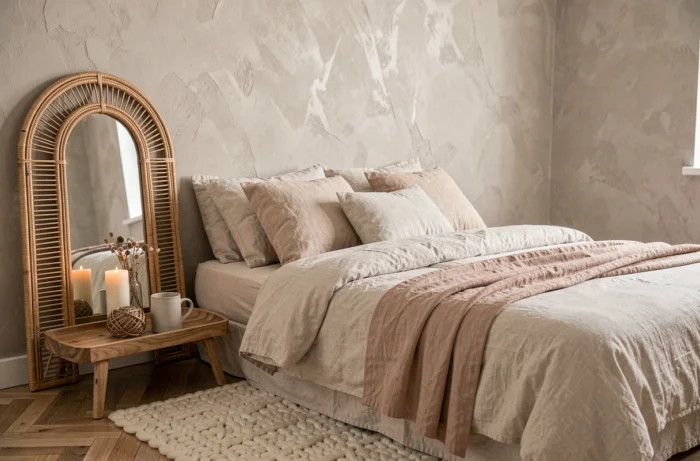
Lighting is no longer just functional illumination. Suspensions made from natural materials (woven rattan, papier-mâché, oxidized metal) serve as statement pieces in the living room or dining room. A sculptural light fixture can alone define the ambiance of a room.
Artisanal ceramics, in the form of vases, bowls, or candle holders, complement this register. Irregular finishes, matte glazes, and organic shapes are sought after precisely for their imperfection, which contrasts with industrial objects.
Limits of decor trends: what catalogs don’t show
Field returns diverge on the actual durability of certain trendy materials. Waxed concrete, for example, requires regular maintenance and can stain irreversibly if the surface treatment is not suitable. Untreated travertine is porous and sensitive to food acids.
Choosing a trendy material without checking its compatibility with the actual use of the room remains the most common mistake. A living room with young children does not have the same constraints as an adult reception space.
The question of budget also deserves to be addressed directly. Authentic raw materials (natural stone, solid wood, quality linen) cost significantly more than their imitations. Available data do not allow for concluding that synthetic alternatives age as well, but they offer an acceptable compromise for accessories that are regularly renewed.
- Check the porosity of a natural stone before using it as a tabletop or countertop.
- Prefer treated raw wood with oil rather than completely untreated, which grays quickly.
- Test a sample of waxed concrete in the relevant room before approving the full installation.
The ESPR regulatory framework and the AGEC law push the market towards greater transparency regarding the composition and end-of-life of decorative products. The digital passport, operational by July 2026, will become a concrete comparison tool for discerning buyers. Until then, the best strategy remains to prioritize pieces whose manufacturing, materials, and provenance are clearly documented, rather than following a trend without measuring its actual longevity.