
A UPS package marked “in transit” beyond the guaranteed delivery date does not automatically trigger a right to a refund. The UPS service guarantee covers certain air, international, and ground services, but its actual scope depends on exclusions that most shippers discover at the time their claim is denied.
UPS Service Alerts: The Invisible Filter Before Any Claim
Before writing anything, we recommend checking the UPS service alerts page. Since 2023-2024, UPS has been publishing ongoing disruptions (bad weather, social movements, network saturation) there and explicitly excludes packages affected by these events from the guarantee.
If your tracking number corresponds to an area or period covered by an active alert, the claim for delay will be systematically rejected by UPS. In this case, the recourse must be redirected to the seller or shipper, who is the only contractual party responsible to the buyer under the French consumer code.
Filing a claim for UPS delivery delay without checking this point is a waste of time on a case destined for rejection. We observe that this preliminary check is absent from almost all available guides, even though it conditions the entire subsequent process.

UPS Claim Window: Deadline and Conditions for Opening
UPS allows you to open a claim for undelivered packages as soon as the delay exceeds twenty-four hours past the scheduled delivery date and time. This threshold assumes that you have previously checked several points.
- The tracking indicates a lack of delivery, not a delivery made to an alternative address or a pickup point
- No neighbor, concierge, or household member has received the package on your behalf
- The tracking status does not mention a delivery attempt with a notice of passage pending rescheduling
The claim must be filed within fifteen calendar days following the scheduled delivery date. After this period, the case becomes inadmissible.
Preparing the File Before Submission
An incomplete file slows down processing and increases the risk of rejection. We recommend gathering the following elements before starting the procedure:
- The complete tracking number of the package and the summary of the service subscribed (UPS Express, UPS Standard, etc.)
- Proof of the guaranteed timeframe: order confirmation, shipping quote, or screenshot of the tracking showing the estimated delivery date
- The amount of shipping fees paid, which constitutes the basis for the service guarantee refund
- Any prior correspondence with UPS customer service (file number, email or chat exchanges)
The refund covers shipping fees, not the value of the contents. For compensation related to the contents, a different type of claim must be opened (damage or loss), with proof of declared value.
UPS Delay Claim Online or by Phone: Concrete Differences
Filing online through the UPS website remains the fastest route. The form requires an active UPS account, the tracking number, and the reason for the claim. Once submitted, the file receives a reference number that allows tracking of progress.
By phone, UPS France customer service handles claims but may not always be able to open a formal file in real-time. The call is more for obtaining clarifications on the package status or resolving an inconsistent tracking situation.
When the Online Channel is Not Enough
If the online response is a denial or prolonged silence, escalation goes through a registered letter with acknowledgment of receipt. This letter must mention the tracking number, the claim file number already opened, the subscribed service, and the unfulfilled guaranteed timeframe.
Under French law, the final recipient does not have a direct contract with UPS unless they are the shipper themselves. The seller remains responsible for the proper execution of the delivery to the buyer. This distinction is crucial: if you are a buyer, your main recourse is directed towards the seller, who can then turn against UPS.
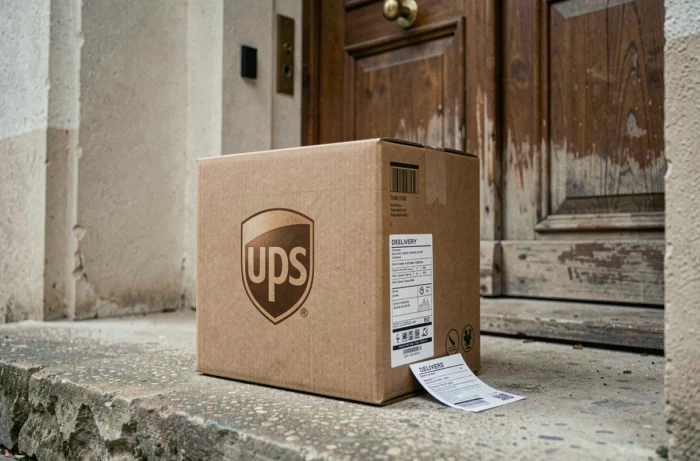
Recourse Outside UPS: Seller’s Responsibility and Mediation
The seller is responsible for delivery until it is effectively received by the buyer. Article L. 216-1 of the consumer code requires the professional to deliver the good within the announced timeframe. In case of delay, the buyer can formally notify the seller by registered letter, then cancel the order and obtain a full refund if the new reasonable timeframe is not met.
This route is often more effective than a direct claim with UPS, as it relies on a clear contractual relationship. The seller, as the shipper and UPS customer, has greater negotiation leverage to obtain a refund or credit from the carrier.
Mediation and Reporting
If the seller does not respond or refuses to take responsibility for the delay, contacting the consumer mediator to which the seller is subject is the next step. This recourse is free for the consumer. In parallel, reporting on the SignalConso platform of the DGCCRF allows documenting the dispute and exerting institutional pressure.
An effective claim relies less on the speed of submission than on the quality of the file and the choice of the right contact person. Checking service alerts, respecting the fifteen-day window, and distinguishing between carrier recourse and seller recourse are the three decisions that separate a processed file from a file classified without follow-up.