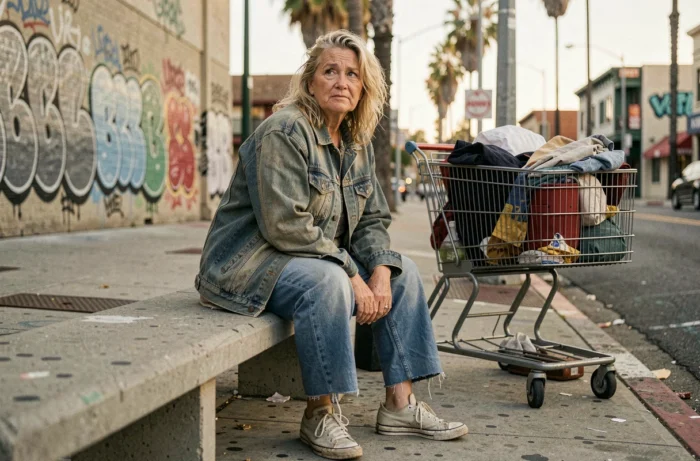
Loni Willison is a former American fitness model, ex-wife of actor Jeremy Jackson, who has been living homeless on the streets of Los Angeles since the second half of the 2010s. In 2024, her name continues to circulate widely on social media, fueled by “before/after” montages that simplify a trajectory much more complex than a mere shift between glamour and misery.
Loni Willison homeless in Los Angeles: the areas where she survives
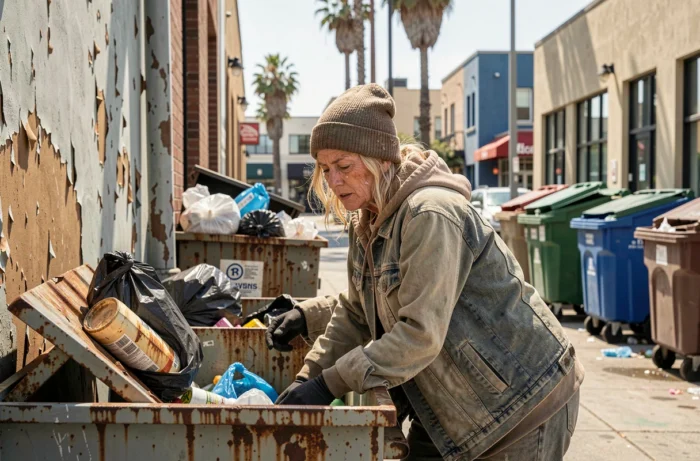
Contrary to the blurry image of a “homeless person somewhere in L.A.” conveyed by viral content, recent observations allow for more precise tracking of her movements. Loni Willison is regularly spotted in Venice Beach, Santa Monica, and Hollywood, where she collects cans and bottles to sell.
This mode of subsistence, based on informal recycling, constitutes her main source of income. It is a common practice among homeless people in California, framed by a deposit system that allows for a few cents to be recovered per container.
An in-depth article recounts Loni Willison’s journey in 2024 by cross-referencing testimonies and verified facts, far from the sensationalist montages that dominate the platforms.
Observations place her within a relatively stable perimeter, contradicting recurring rumors of “disappearance” that circulate during every media lull. Loni Willison has not disappeared; she survives in an identifiable urban territory.
Refusal of help and sense of safety on the street: understanding the logic
The media reflex is to present Loni Willison’s situation as a simple failure of intervention: “help was offered, she refused.” This reading overlooks a documented mechanism in street psychiatry.
According to available testimonies, Loni Willison consistently and repeatedly refuses help from those around her, her family, and social services. She explains that she paradoxically feels safer on the street than in a structured environment or under the control of others.
This type of refusal is not a whim. It fits into a logic where returning to a structured environment is perceived as a threat, often because it revives past experiences of loss of control. Several factors contribute to this stance:
- A divorce from Jeremy Jackson associated with accusations of domestic violence, which has permanently undermined her trust in close relationships.
- A substance dependency that, according to available accounts, began or worsened during the marriage, reinforcing the link between “structured life” and suffering.
- A gradual isolation that severed ties with support structures before they could intervene effectively.
This refusal, far from being a one-time episode, remains her position in 2024 and beyond. Understanding this requires accepting that the street may represent, for some people, a space of minimal control over their own existence.
Voluntary degradation of appearance: a protective mechanism
Viral videos emphasize the contrast between modeling photos and recent snapshots. What is almost never addressed is the functional dimension of this physical transformation.
Analyses relayed by specialized sources describe a form of voluntary degradation of appearance as a survival strategy. For a woman living alone on the street, appearing less “attractive” or less vulnerable reduces certain risks of aggression.
This protective mechanism is documented among other homeless women. It is not a matter of “letting oneself go” but of adapting to a hostile environment. The “before/after” content that treats this change as a mere decline misses this reality.
Loni Willison and social media: a narrative frozen for years
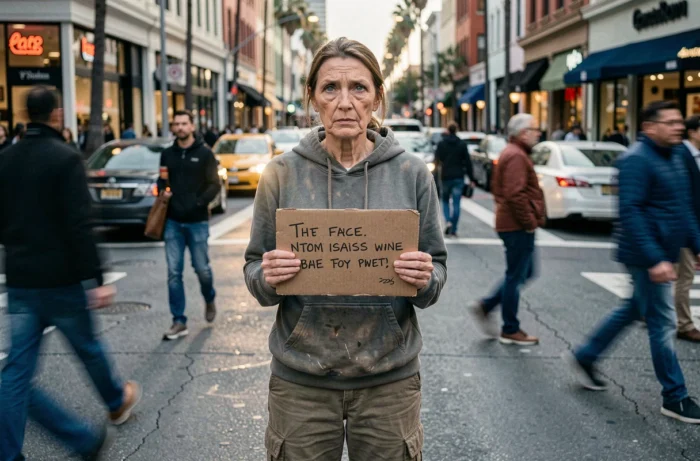
The name Loni Willison generates millions of views on TikTok, Instagram Reels, and YouTube Shorts. The format is always the same: glamorous photos, then street snapshots, dramatic music, overlaid text. The creators change, but the script remains the same.
The problem with this constant recycling lies in three points:
- No new information is added from one video to the next. The same photos have circulated for years, sometimes without dating.
- Mental health issues and addiction are presented as certainties, even though no public diagnosis has been confirmed by a health professional directly following her.
- The narrative systematically reduces her journey to a linear fall (model, marriage, divorce, drugs, street), erasing all complexity.
Addiction is used as the sole lens of understanding, while the factors keeping a person on the street are multiple: access to care, housing, social network, mental health, relationship with institutions.
What viral videos do not show
The fascination with the “before/after” relies on a simple cognitive bias: the visual contrast provokes a strong emotion, which encourages sharing. But this mechanism transforms a real person into a narrative support.
Loni Willison has not granted any structured interviews in recent years. The snippets of speech reported come from chance encounters with photographers or passersby. Constructing a complete narrative from these fragments is more about projection than journalism.
Loni Willison remains alive and still homeless in Los Angeles, according to the most recent observations. Her story illustrates less a spectacular individual fate than the concrete limits of the Californian safety net in the face of people who do not ask for help.