
An automotive diagnosis is not limited to connecting an OBD scanner and reading fault codes. The raw reading of DTCs (Diagnostic Trouble Codes) only reveals a symptom, never the root cause. Identifying a P0300 (random misfires) without cross-referencing real-time sensor data is addressing a warning light, not a failure. Here, we detail the technical points that make the difference between a superficial diagnosis and a truly actionable analysis for preventive maintenance.
OBD Protocols and Access to Manufacturer Data: What Changes in 2026
Access to diagnostic data via the OBD-II port remains the foundation of any intervention. The standardized connector (16 pins, ISO 15031 standard) allows for reading generic fault codes (P0, P1, P2) on all vehicles since the late 1990s.
However, manufacturer-specific proprietary codes require a tool compatible with the brand’s specific protocol. A low-cost generic OBD reader will never retrieve the sub-codes from a Renault automatic transmission ECU or a Toyota hybrid module. This is a structural limitation that many consumer guides overlook.
In 2026, OBD access rules will evolve for independent workshops. The challenge lies in the ability to query the ECUs of electric and hybrid vehicles, whose software architecture is more locked down. A workshop that settles for a generic automotive diagnosis loses relevance against these multiplexed architectures.
Difference Between Code Reading and Active Diagnosis
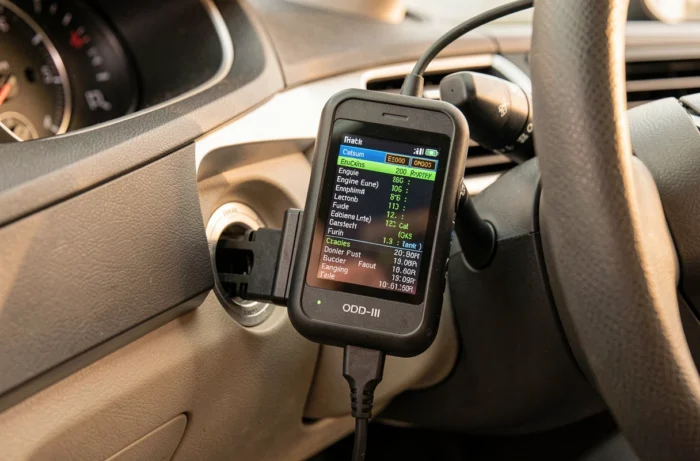
Passive reading (retrieving stored DTCs) represents only a fraction of the diagnosis. Active diagnosis involves controlling actuators from the tool: forcing the opening of an injector, commanding a rail pressure test, activating a turbo solenoid. This functionality is only available on professional or semi-professional diagnostic tools.
Without active diagnosis, it is impossible to confirm the failure of a component identified by a fault code. We recommend always cross-referencing the DTC with at least one real-time parameter measurement (pressure, temperature, voltage) before replacing a part.
Safety Recalls and Technical Control: The Takata Airbag Trap
Since January 1, 2026, a vehicle equipped with a Takata airbag classified as “stop drive” is automatically placed in re-inspection, even if all other points are compliant. The decree of December 8, 2025 (n° 2025-1180) requires technical inspection centers to systematically check certain serious safety recalls.
In practical terms, a complete automotive diagnosis can no longer ignore the history of manufacturer recalls. Checking mechanical and electronic compliance without consulting ongoing recall campaigns exposes one to an unexpected re-inspection, or even a prohibition to drive.
How to Check Recalls Before a Technical Inspection
- Consult the manufacturer’s website with the vehicle’s VIN to identify any outstanding recalls, particularly those classified as “stop drive.”
- Cross-reference the information with the digital maintenance log or dealer invoices, as some recalls are performed without notifying the subsequent owner.
- Anticipate the replacement of affected parts several weeks before the technical inspection date, as lead times can be long for Takata components.
Technical inspection centers now collect owners’ contact information for the most serious recall campaigns, which enhances traceability but does not exempt one from proactive checking.
Diagnosis of Hybrid and Electric Vehicles: Technical Specificities
The high-voltage architecture of an electric or hybrid vehicle imposes radically different diagnostic procedures from those of a thermal engine. The battery pack, DC/DC converter, inverter, and electric motor generate specific fault codes that do not appear in generic OBD databases.
On a hybrid, the diagnosis must simultaneously cover both the thermal and electrical chains. An insulation fault on the high-voltage circuit (measured in megaohms) can trigger a thermal engine fault code as a side effect, even if no thermal component is actually at fault.
Critical Parameters to Monitor on a Battery Pack
The state of health (SOH) of the battery pack cannot be read with a simple OBD reader. It is necessary to access the data cell by cell to identify a voltage imbalance between modules. A voltage difference exceeding the threshold defined by the manufacturer between two cells indicates early degradation that will not yet appear as a fault code.
The charge and discharge temperature, the number of complete cycles, and the internal resistance of the cells are the three parameters we consider as priorities during preventive diagnostics on electric vehicles.
Automotive Diagnostic Tool: Selection Criteria for Regular Use
The market offers tools ranging from OBD readers under fifty euros to professional diagnostic stations. The choice depends on three factors: manufacturer coverage, depth of access to ECUs, and frequency of software updates.
- A basic OBD reader (ELM327 or equivalent) is sufficient to read and clear generic fault codes, but does not allow for active diagnosis or access to specific ECUs (ABS, airbag, automatic transmission).
- A mid-range multi-brand scanner covers the majority of European and Asian vehicles with access to manufacturer codes, real-time data, and some reset functions (oil change, brake pads).
- Professional tools integrate active diagnosis, ECU reprogramming, and firmware updates, functions necessary for recent vehicles and hybrid or electric architectures.
The frequency of updates is a criterion often overlooked. A tool whose database is not updated at least once a year quickly loses compatibility with new models and software developments from manufacturers.
An effective automotive diagnosis relies on the combination of a suitable tool, a rigorous method of cross-referencing data, and a systematic check of manufacturer recalls. Since 2026, ignoring the history of recall campaigns can result in a re-inspection, regardless of the mechanical condition of the vehicle.