
When looking for a real estate interlocutor capable of covering sales, rental management, and concierge services in the same area, the clarity of the offer is as important as field expertise. Immo Saga structures its services around these three axes, with one particularity: each service is designed to connect with the others, which changes the way a property owner manages their asset on a daily basis.
Integration of real estate services at Immo Saga: transaction, management, and concierge
Most agencies offer sales on one side and rental management on the other, without any real bridge between the two. Immo Saga connects these professions in a unique journey. A property owner selling a property can switch to managing another without changing interlocutors, and vice versa.
This integrated approach avoids information breaks. The rental manager knows the property’s history because they have followed the transaction or the initial valuation. The concierge service intervenes downstream for owners who rent seasonally: key handover, cleaning, guest follow-up.
| Service | Covered scope | Link with other services |
|---|---|---|
| Transaction (sale/purchase) | Valuation, dissemination, negotiation, signing | Direct transfer to rental management if the new owner rents |
| Rental management | Tenant search, collection, technical follow-up | Data sharing with the concierge for furnished rentals |
| Concierge | Guest reception, maintenance, ad management | Support on rental expertise to set seasonal rates |
By consulting the presentation of the Immo Saga website, one can measure the coherence between these three branches: each service page links to the others, reflecting the internal functioning of the agency.

Compliance of furnished tourist accommodations: an issue that few agencies integrate into their offer
The Le Meur law has reshaped the regulatory framework for seasonal rentals. Municipalities can now reduce the rental ceiling of a primary residence from 120 to 90 days. National registration via a unique tele-service is becoming widespread, and platforms can block listings without a registration number.
For an owner renting out furnished tourist accommodations, these changes are not trivial. A non-compliant listing can disappear overnight. The energy performance diagnosis (DPE) also becomes a compliance criterion for properties subject to a change of use authorization, with a trajectory of tightening expected until 2034.
What this changes for an owner supported by an agency
An agency that offers concierge services without integrating this regulatory monitoring exposes its clients to a concrete risk. Immo Saga positions its concierge service as one that includes administrative follow-up of listings, not just guest logistics.
- Verification of the registration number before publication on platforms, to avoid automatic blocking of listings
- Monitoring of the rental day ceiling applicable in the property’s municipality, with alerts before exceeding
- Support on the energy performance diagnosis when the property falls under the new obligations
This regulatory layer distinguishes a concierge service from simple management from a true compliant seasonal rental management service.
Valuation and real estate expertise: local database as an advantage
The valuation of a property relies on a fine understanding of the local market. Online valuation tools provide a range, but they struggle to incorporate the specifics of a neighborhood, a condominium, or a particular type of property (chalet, apartment in a resort, village house).
Immo Saga capitalizes on the transactions it has conducted itself. Each past sale feeds into an internal reference database that allows for more accurate valuations. An apartment sold in the same building six months earlier provides a much more reliable comparable than a national algorithm.
Condominiums and furnished rentals: a specific point of vigilance
Condominiums now have a simplified lever to prohibit the activity of furnished tourism. This possibility, reinforced by the Le Meur law, changes the value of a unit depending on whether the condominium allows seasonal rentals or not.
An agent who values a property without checking this point may overestimate an apartment whose condominium has just voted to prohibit it. Integrating this data into the valuation means providing a realistic market price, not a flattering figure.
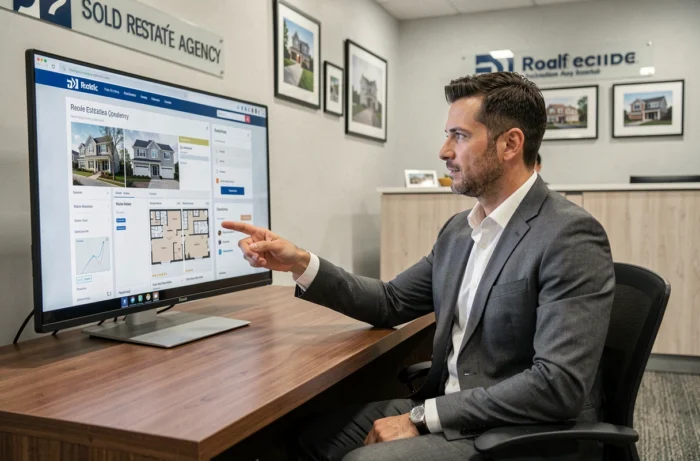
Integrated real estate services: comparison of common models
The real estate agency market offers several configurations. Comparing them helps to situate the Immo Saga model within the landscape.
| Agency model | Transaction | Rental management | Concierge | Regulatory monitoring for furnished rentals |
|---|---|---|---|---|
| Traditional agency | Yes | Sometimes | No | No |
| Specialized concierge | No | No | Yes | Variable |
| National online network | Yes | Yes | Rarely | No |
| Integrated agency (like Immo Saga) | Yes | Yes | Yes | Yes |
The integrated model concentrates information in one place. A single interlocutor follows the property from valuation to daily management, which reduces information loss between distinct providers.
On the other hand, this model assumes that the agency has multidisciplinary skills. The quality of service depends on the actual ability of the team to master each profession, not just to display them on a website.
The strengthening of obligations regarding furnished tourism (national registration, DPE, rental day ceilings) makes the regulatory dimension as crucial as commercial know-how. A comprehensive real estate service now integrates compliance as a core service, not as a bonus. It is on this ground that the difference between an agency that manages and an agency that protects is played out.