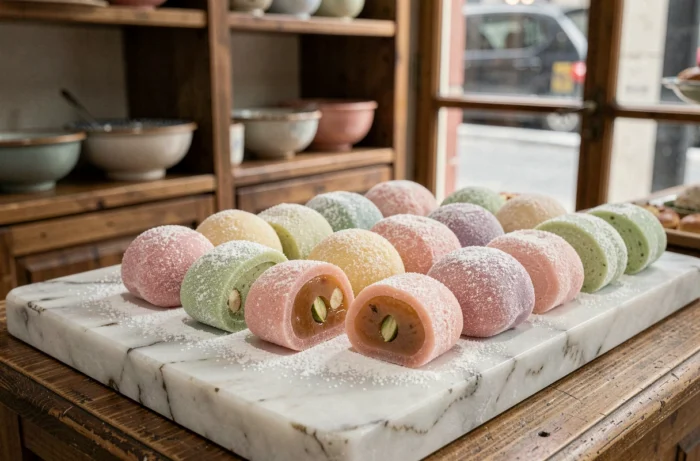
Not all Turkish delights display the same nutritional profile, and their shelf life depends less on additives than on specific storage conditions. Between a plain rose Turkish delight and a pistachio-filled version, the caloric difference can be surprising. Understanding these differences allows for better consumption management and helps avoid wasting a poorly stored product.
Caloric difference by type of Turkish delight: comparative table
The nutritional values of a Turkish delight change radically depending on its recipe. A classic Turkish delight, made from sugar and starch flavored with rose, remains a very sweet product but low in fat. As soon as nuts (pistachios, walnuts, almonds) are added, the energy density increases due to the lipids.
| Type of Turkish delight | Dominant profile | Relative caloric density |
|---|---|---|
| Plain Turkish delight (rose, bergamot) | Simple sugars, almost no lipids | Moderate |
| Fruit Turkish delight (pomegranate, lemon) | Simple sugars, sometimes fruit puree | Moderate to slightly higher |
| Nut Turkish delight (pistachio, walnut) | Sugars + lipids from nuts | Significantly higher |
| Industrial coated Turkish delight (chocolate, coconut) | Sugars + added lipids | The highest |
The lesson to remember: the calorie content of Turkish delight depends as much on the nuts as on the sugar. A rose Turkish delight and a pistachio Turkish delight do not belong to the same category, even if their size is identical.
Before choosing between two boxes, it is better to think in terms of labels and recipes rather than generic categories. An article detailing the storage and calories of Turkish delights confirms that these differences are often underestimated by consumers.

Turkish delights and sugar: why portion size matters
Turkish delight is, by definition, a confectionery with a high sugar content. Its base, a sugar syrup bound by starch, makes it a product where simple carbohydrates represent the majority of the energy intake in classic versions.
In contrast, a nut-filled Turkish delight derives a significant portion of its calories from lipids. The nutritional profile shifts: less sugar proportionally, but more fats and a higher overall caloric density.
Adjusting the quantity based on the type consumed
One or two plain Turkish delights can accompany a coffee without notable excess. The standard portion remains small, which mechanically limits caloric intake. With nut-filled Turkish delights, the same quantity weighs more in terms of energy.
- Plain Turkish delight (rose or bergamot): two pieces remain reasonable at the end of a meal, their lipid contribution being almost nil
- Pistachio or walnut Turkish delight: one piece is enough for a snack, the presence of nuts increasing satiety but also the caloric load
- Industrial coated Turkish delight: always check the label, as the coating (chocolate, shredded coconut) adds a layer of often invisible calories
The useful reflex is not to banish Turkish delight, but to read the label rather than rely on the size of the piece.
Storage of Turkish delights: the refrigerator is a false good idea
Many people instinctively store their Turkish delights in the refrigerator. The result is often disappointing: condensation softens the powdered sugar coating, the texture becomes sticky, and the product loses its characteristic appearance.
Storage at room temperature remains the norm for traditional Turkish delights. Manufacturers rely on strict storage conditions rather than chemical preservatives: dry environment, away from heat, airtight packaging once opened.
Appropriate storage conditions
A well-stored Turkish delight retains its melting texture and powdery coating for several weeks. Recent product sheets from both artisanal and industrial brands converge on the same recommendations.
- Stable room temperature, ideally below 25 degrees, in a cupboard away from direct light
- Airtight container (metal box, glass jar with a seal) to prevent the Turkish delight from absorbing ambient moisture
- Separation of layers with parchment paper if pieces are stacked, to prevent them from sticking together
- Away from any heat source (oven, sun-exposed window) that accelerates the drying of the paste
The classic trap: taking Turkish delights out of the refrigerator and leaving them in the open air. The thermal shock causes condensation on the surface, which destroys the coating within a few hours.
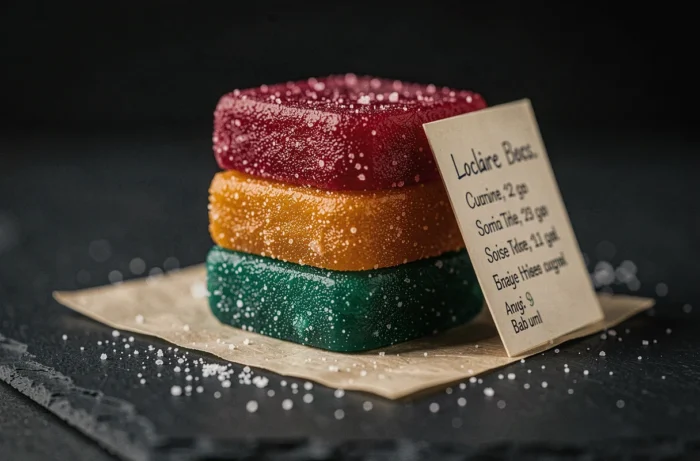
Additives and storage: what recent labels say
Several Turkish delights sold in Europe bear the label “no preservatives” on their packaging. This label is technically accurate in most cases: the high sugar concentration of the product acts as a natural preservative by limiting the activity of water available for microorganisms.
Some industrial products may contain additives such as potassium sorbate (E202) or sorbic acid (E200), used as preservatives. These additives are subject to regulatory oversight at the European level, with recent normative corrections on the allowed doses in confections.
Artisanal or industrial Turkish delight: a choice of preservation
An artisanal Turkish delight without additives stores well as long as the storage rules described above are followed. Its shelf life is shorter than that of a stabilized industrial product, but its texture and flavors remain superior in the first weeks.
An industrial Turkish delight tolerates temperature and humidity fluctuations better due to its packaging under controlled atmosphere. The compromise lies between extended shelf life and suitable taste quality.
The most reliable criterion remains the minimum durability date indicated on the packaging, combined with a visual check: a Turkish delight whose coating has melted or whose paste shows signs of moisture has exceeded its ideal storage conditions, even if the date has not been reached.