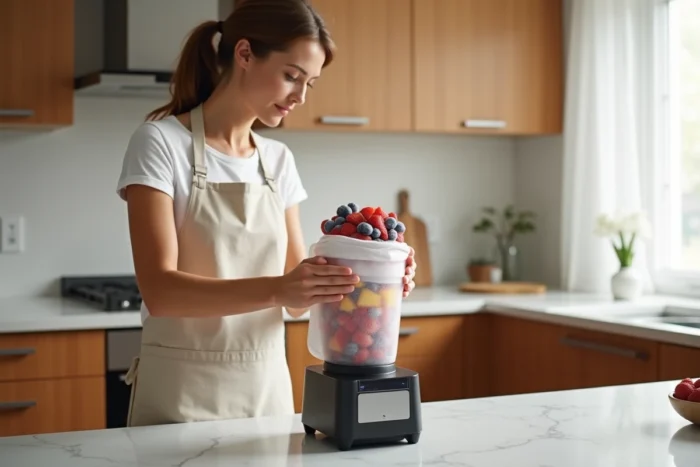
A thick, icy smoothie with a beautiful bright color: that’s what frozen fruits promise. In practice, many people find themselves with a blender that struggles, a result that’s too liquid, or on the contrary, a compact block that’s impossible to blend. Using frozen fruits in a blender requires a few simple habits, but they make all the difference in the texture and lifespan of your appliance.
Liquid first in the blender: the rule that protects the motor
Have you ever poured a handful of frozen fruits directly into the blender bowl, started the machine, and heard a dull noise without anything moving? This blockage almost always comes from a lack of liquid at the bottom of the bowl.
Blender and food processor brands specify in their user guides: always pour the liquid base before the frozen fruits. Milk, water, fruit juice, plant-based drink, it doesn’t matter. This liquid creates a whirlpool (the vortex) that pulls the pieces towards the blades. Without it, the fruits get stuck and the motor runs empty.
The minimum amount is around a small glass for a single serving. If you’re preparing a thicker smoothie bowl, slightly reduce the liquid but never go below this threshold. A blender running dry on hard fruits, even for a few seconds, can damage its blades or overheat its motor.
For those wondering if you can put frozen fruits in a blender with Gourmandel, the answer is yes, as long as you respect this filling order.
Tempering frozen fruits before blending: the underestimated gesture
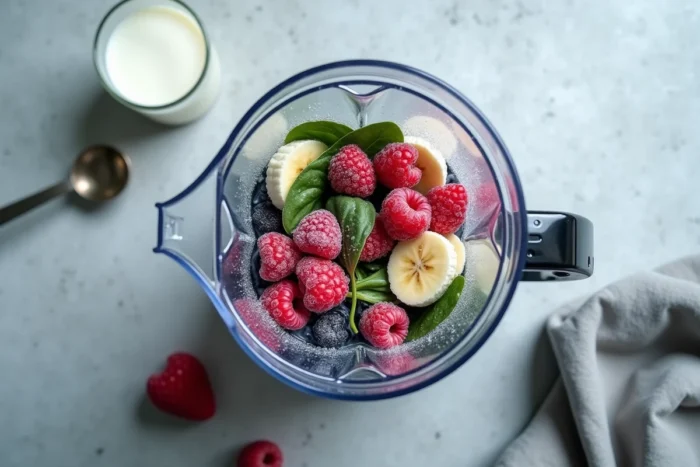
Taking a bag out of the freezer and dumping it directly into the blender seems logical. After all, we want a nice cold smoothie. But letting the fruits temper for five to ten minutes on the countertop changes the game.
During this short rest, the surface of the pieces softens just enough for the blades to catch without forcing. Blending starts faster, the texture becomes more homogeneous, and the motor heats up less. On a moderately powered appliance, this step makes the difference between a successful smoothie and a pile of poorly crushed pieces.
This tempering time does not compromise the freshness of the result. The fruits remain nice and cold in the center, which maintains the icy texture of the smoothie once blended.
Pulse before continuous blending: preserving texture
Instead of starting the blender at full speed right away, begin with a few short pulses. Alternating pulses and continuous blending allows you to break the larger pieces without creating air pockets under the blades.
Specifically, three to five presses on the pulse button are sufficient. The pieces fragment, the liquid circulates better, and you can then switch to continuous speed for a smooth blend. This technique also applies when you’re making an express sorbet in the blender, where the temperature must remain as low as possible.
Pre-prepared smoothie packs: the meal prep that simplifies everything
Preparing a smoothie every morning takes time if you have to open three bags, measure, and rinse fresh fruits. A more efficient approach is to prepare individual bags of fruits ready to blend.
The principle is simple: you pre-portion your frozen fruit mixes (and possibly vegetables like spinach) into freezer bags, one bag per smoothie. In the morning, you dump the bag into the blender, add the liquid, and blend. Less than two minutes between the freezer and the glass.
- A typical “tropical” bag: mango, pineapple, banana sliced into rounds.
- A “red fruits” bag: raspberries, blueberries, strawberries, with a handful of oats to thicken.
- A “green” bag: banana, fresh spinach, a few pieces of pear, chia seeds.
If you transfer the bag from the freezer to the refrigerator about ten minutes before use, the fruits temper just enough for smooth blending. This gesture combines the time-saving aspect of meal prep with the tempering technique mentioned earlier.
Texture of the smoothie with frozen fruits: adjusting thickness without diluting everything
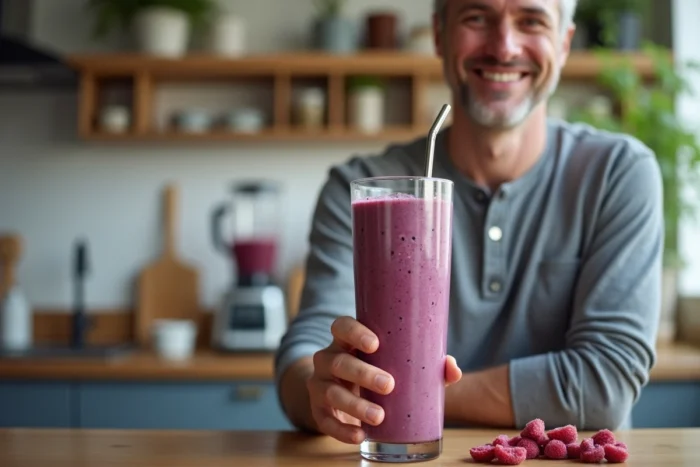
A smoothie that’s too liquid is disappointing. Too thick, it can’t be drunk through a straw. The texture depends on the ratio of frozen fruits to liquid, not on a miracle ingredient.
To thicken a smoothie without adding industrial powder:
- Increase the proportion of frozen banana, which adds body and natural binding.
- Add a spoonful of peanut butter or almond puree for a creamy consistency.
- Integrate oats directly into the blender: they blend finely and absorb excess liquid.
To thin out a mixture that’s too compact, add the liquid in small amounts, with the motor running at low speed. One to two tablespoons are often sufficient. Pouring a large volume all at once turns the smoothie into fruit juice, which is not the goal.
Frozen vegetables in a smoothie: a discreet addition that changes the game
Spinach and kale freeze very well and blend without noticeably altering the smoothie’s taste. Their flavor is masked by the sweet fruits (mango, banana, red fruits). Freezing vegetables in individual portions makes it easier to integrate them into your meal prep packs.
In terms of texture, frozen leafy vegetables blend more easily than fresh ones, as freezing breaks down the plant fibers. The result is smoother, without unpleasant strands.
The last point to keep in mind concerns the power of your appliance. A portable blender or an entry-level mixer handles red fruits and banana well but may struggle with very hard frozen pieces of mango or pineapple. In this case, tempering and pulsing become not optional, but essential to avoid overheating and preserve the lifespan of the motor.