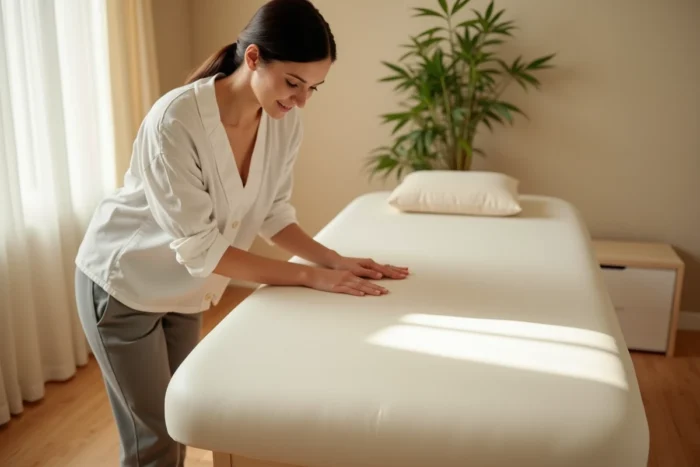
Installing a massage table at home often means wanting to replicate the comfort of a session in a clinic without the travel. However, the choice of model depends on very concrete constraints: the available space in the room, the frequency of use, and the type of massage practiced. A table that is too narrow spoils relaxation, while a table that is too heavy ends up stored in a closet.
Static load and working load: two values to distinguish on the technical sheet
When consulting a technical sheet, the displayed weight capacity almost always corresponds to the static load, meaning the weight that a stationary user can place on the surface. This value is reassuring, but it does not reflect the actual conditions of a massage.
During a session, the masseur applies pressure, changes support, and sometimes works with their elbows. These dynamic forces stress the structure much more than a simple resting weight. It is the dynamic working load that determines the actual safety of the table.
There are models for which specialized guides distinguish static capacities of several hundred kilograms, while the capacity under working conditions is significantly lower. Before purchasing, ask the seller or manufacturer for the recommended working load, not just the static figure.
If this information is not available, move on. To compare models suitable for home use, you can refer to the massage table which lists detailed sheets by category.
Thickness and foam density: the true comfort criterion at home
Competitors detail the width, length, and covering. But at home, where one often massages a loved one for an hour or more, it is the foam density that makes the difference over time.
Foam that is too soft compresses in a few minutes and reveals the rigid structure underneath. High-density foam retains its bounce and distributes body weight evenly. The covering (PU, PVC, or synthetic leather) plays a secondary role compared to what happens underneath.
How to evaluate foam without trying it in-store
Few individuals have access to a showroom. You can rely on two indicators:
- The thickness of the mattress: below five centimeters, comfort drops quickly during long sessions. Models offering generous thickness, often starting from seven or eight centimeters, are better suited for relaxation use at home.
- The mention of “high density” or “high resilience” foam in the description. If only the thickness is indicated without details on density, the foam is likely low quality.
- User feedback after several months: foam that seems fine upon unpacking can sag in a few weeks. Long-term reviews are more reliable than first impressions.
Feedback varies on this point among manufacturers, but the rule remains the same: always prioritize density over raw thickness.
Aluminum or wood folding table: a weight-stability trade-off unique to each home
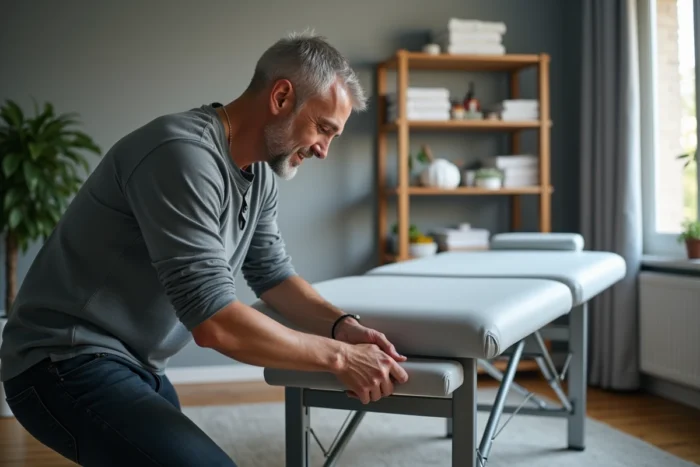
At home, the table is stored after each use in most cases. Weight then becomes a daily criterion, not just a technical detail.
Aluminum frames easily come in under fifteen kilograms. They can be moved from one room to another effortlessly and slid behind a piece of furniture or into a closet. In return, they vibrate more under the firm pressure of the masseur.
Wood frames (beech or maple) offer superior stability and absorb vibrations better. However, their weight often exceeds twenty kilograms, complicating frequent storage, especially in an upper-floor apartment without an elevator.
The right reflex before buying
Measure the space where you plan to install the table, adding at least fifty centimeters on each side so that the masseur can move around. Also check the dimensions when folded: some compact models in use become cumbersome in suitcase form.
Adjustable height: adapting the table to the masseur, not the recipient
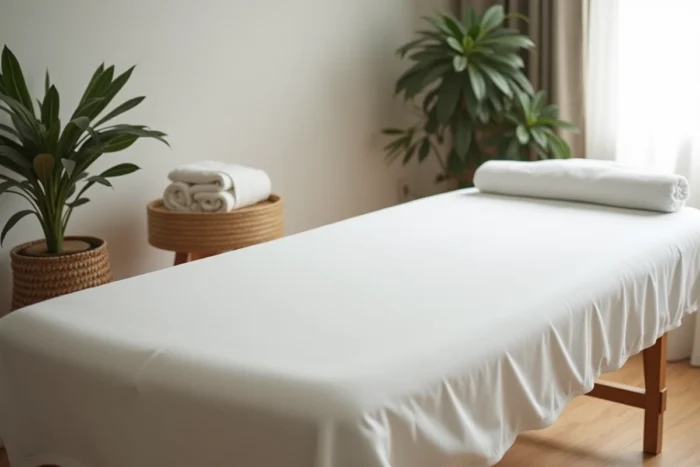
One often thinks of the comfort of the person lying down, but the height of the table primarily affects the posture of the one doing the massage. A table that is too high forces the shoulders up, while a table that is too low requires bending over. In both cases, back pain can arise quickly.
For home use, telescopic leg systems with button or cable locking are perfectly suitable. The height can be adjusted in seconds without tools. Electric or hydraulic systems, more common in clinics, add weight to the table and increase the price without providing a real benefit for occasional massage at home.
The right height is tested standing, arms at the sides: the surface should reach wrist level. This simple guideline avoids most adjustment errors.
Useful accessories and superfluous accessories for home use
Manufacturers offer packs with headrests, roll holders, armrests, and transport covers. Not everything is necessary when the table does not leave the home.
- The adjustable headrest is the only truly useful accessory: it allows the recipient to keep their neck aligned in a prone position, which radically changes comfort during a long session.
- The half-moon cushion (or bolster) placed under the ankles relieves the lower back when lying down. A simple sofa cushion can serve this purpose.
- The transport cover is only useful if you move the table. For strictly domestic use, it remains in its packaging.
Focus the budget on the quality of the surface and foam rather than on an accumulation of rarely used accessories. A well-chosen table, with dense padding and an appropriate height, covers most home massage needs for a reasonable budget.