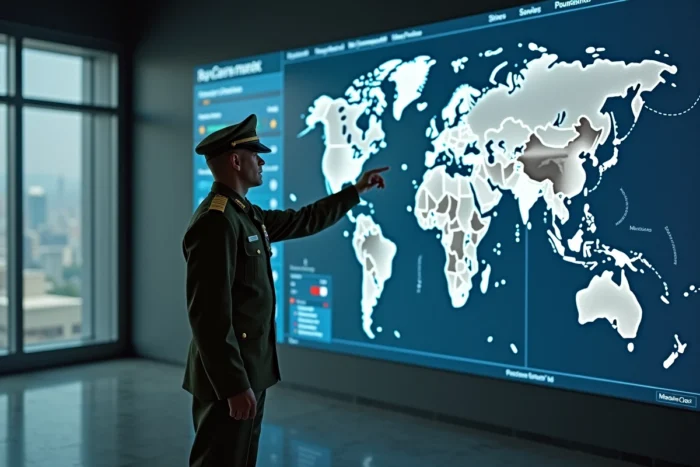
When looking at the military personnel figures aligned by Global Firepower for 2026, the United States, Russia, and China unsurprisingly occupy the top three spots. The ranking covers 145 countries and aggregates over 60 factors, from the number of tanks to defense budgets. However, this year, several movements in the table raise questions: France drops one rank, South Korea confirms its rise, and some armies progress without any change in their budgets.
Drones and Cyber Defense: The Bottlenecks Ignored by the Military Ranking
On the Ukrainian battlefield, it has been observed for several months that the ability to produce and deploy drones en masse changes the balance of power faster than ordering tanks. Armies that adapt their doctrine in a matter of weeks gain an advantage that the Global Firepower ranking does not measure.
The problem is structural. The PwrIndx index aggregates quantitative data (number of aircraft, soldiers, ships) without weighing tactical adaptation speed or a country’s cyber maturity. An army equipped with thousands of armored vehicles but unable to protect its communication networks finds itself paralyzed within the first hours of a hybrid conflict.
Official French documents highlight this gap: the issues of volume, regeneration, logistical support, munitions, and drones have returned to the forefront of discussions on high intensity. By consulting the global military power ranking 2026, one can measure the gap between raw numbers and operational reality.
French Defense Budget Rising, Rank Falling: The Paradox of France in 2026
France drops to 9th place in the 2026 ranking. This drop of one rank may be surprising given that the finance bill project anticipates a new funding step within the framework of the military programming 2024-2030, with additional billions earmarked for defense.
This touches on a point that rankings often obscure: a rising budget does not produce immediate capacity effects. Ordering a nuclear submarine or modernizing a fleet of combat aircraft takes years from the contract signing to operational delivery. The armies that progress in the ranking are sometimes those that reap the benefits of investments made a decade earlier.
What Military Programming Changes Concretely
The French military programming law emphasizes several concrete axes:
- Accelerating orders for munitions and drones, identified as critical consumables in high-intensity conflicts
- Strengthening logistical support and the regeneration capacity of equipment, a line item often underfunded in the past
- Enhancing the command of actions in cyberspace, recently created to structure military cyber defense
These investments will only reflect in the Global Firepower indices over several ranking cycles. France remains the leading military power in the European Union, but its global rank now depends on its ability to transform its budgets into deployable capabilities.
South Korea and Turkey: The Progressions That Matter in the 2026 Global Military Ranking
South Korea maintains its position in the global top 5. Its position relies on a high-performing defense industrial base, capable of producing tanks, aircraft, and artillery systems that are massively exported. Unlike powers whose rankings primarily reflect demographic size, South Korea combines volume and technological sophistication.
Turkey is also progressing, driven by the development of its combat drones (feedback from the Syrian and Libyan theaters has accelerated industrial iterations). The ability to export weapon systems boosts the score in the Global Firepower methodology, as it demonstrates an autonomous industrial base.
Germany: A Special Case in Europe
Germany remains around the twelfth place despite the announcement of a massive special fund for the modernization of the Bundeswehr. Feedback varies on this point: some analysts believe the effects will be felt in the upcoming cycles, while others highlight that German administrative burdens slow down transformation. For now, the ranking does not yet reflect recent budgetary commitments.

Reading a Global Military Ranking Without Falling into the Trap of Raw Numbers
It would be a mistake to take these rankings as a prediction of victory in the event of conflict. A country ranked 30th may have an army perfectly suited to defend its territory, while a power in the top 10 may find itself struggling against an asymmetric adversary.
The conflict in Ukraine serves as a laboratory for military innovation in real conditions. Armies that learn from it adapt their doctrines faster than what statistical tables can capture. Drone warfare, electronic warfare, logistical resilience under fire: these are dimensions absent from the Global Firepower columns.
Three reflexes help better interpret this type of ranking:
- Check if the country has a national defense industry or relies on imports for its critical equipment
- Look at the ratio between active soldiers and mobilizable reservists, which reveals the actual strategic depth
- Seek recent operational experience feedback, the only reliable indicators of an army’s combat capability
The United States retains the top spot thanks to a unique combination of power projection, military bases spread across all continents, and an unparalleled defense budget. Russia and China complete the podium, but for very different reasons: human mass and territorial depth on one side, accelerated modernization of naval and space capabilities on the other.
The 2026 military power ranking reminds us of one simple thing: numbers measure means, not results. What separates a paper army from an operational force is its ability to deploy, sustain, and adapt its means under pressure. Future editions will need to incorporate these dimensions to remain relevant.