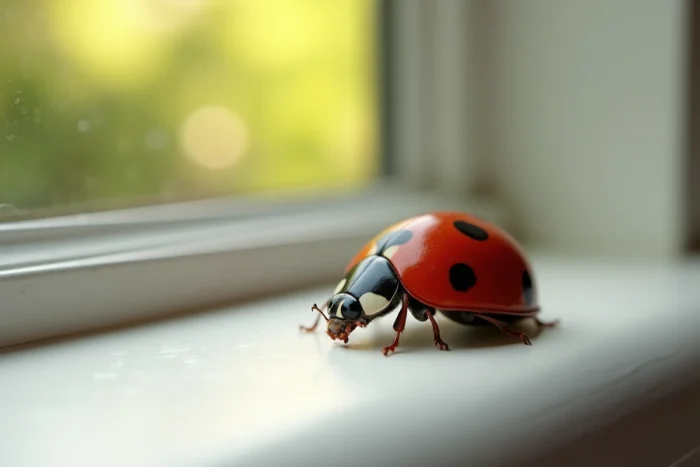
When a ladybug appears in a living room or on a windowsill, the first reaction swings between curiosity and seeking meaning. The ladybug in the house and its spiritual significance vary according to traditions, observed species, and seasonal context. Comparing these interpretative frameworks allows us to distinguish what pertains to cultural symbolism, entomological behavior, and personal interpretation.
European ladybug or Asian ladybug: two visitors, two interpretations
Most pages dedicated to the symbolism of the ladybug treat the insect as a unique entity. The entomological reality complicates this approach. The ladybugs that invade homes in autumn often belong to the species Harmonia axyridis, the invasive Asian ladybug, introduced for biological control and now invasive in Europe.
This distinction changes the game for anyone wondering about the spiritual meaning of the ladybug in the house during its visit. The seven-spotted ladybug, the traditional bright red “ladybird,” rarely enters in numbers into a habitat. The Asian ladybug, on the other hand, gathers in dozens or even hundreds in attics and window frames to hibernate.
| Criterion | Seven-spotted ladybug (Coccinella septempunctata) | Asian ladybug (Harmonia axyridis) |
|---|---|---|
| Dominant color | Bright red, fixed black spots | Variable: red, orange, sometimes almost black |
| Number of spots | Always seven | Inconsistent, from zero to more than twenty |
| Winter behavior | Hibernates in vegetation, rarely indoors | Actively seeks heated buildings |
| Group presence | Solitary | Aggregates of several dozen individuals |
| Traditional interpretation | Associated with the Virgin Mary, a lucky charm | No popular tradition attached |
The symbolic frameworks that attribute meaning to the number of spots or color lose their coherence in the face of a species whose characteristics vary from individual to individual. An autumn invasion pertains to entomology, not spirituality: it signals a seasonal survival behavior and a dwelling presenting attractive micro-openings.

Spiritual meaning of the ladybug: what traditions say
The symbolism of the ladybug as a sign of protection, luck, and happiness crosses several cultures. The French nickname “bête à bon Dieu” anchors the insect in a medieval Christian tradition where the bright red seven-spotted ladybug represented a divine messenger and symbol of protection.
In contemporary spiritual readings, the presence of a ladybug in the house is associated with three main axes:
- A sign of luck or renewal, often linked to an imminent positive change in personal or professional life
- A message of gentleness and trust, inviting one to slow down and welcome events with serenity
- A reminder of protection, with the ladybug playing a symbolic role as a guardian of the home
These interpretations are found in literature on totem animals, where the ladybug embodies simple joy and the ability to transform small moments into occasions for gratitude.
The trap of overinterpretation by color and number of spots
Several sites assign distinct meanings based on color (red for love, yellow for creativity, black for transformation). This framework poses a factual problem. The natural variability of Asian ladybugs makes these correspondences arbitrary. An orange ladybug with three spots and another black one with seventeen spots can belong to the same species.
Reading a spiritual message in the color of an insect whose pigmentation varies genetically within the same population is akin to seeking a horoscope in a random draw. Popular tradition, however, has never relied on color: the “bête à bon Dieu” was always red with seven spots, and it is this consistency that founded the symbol.
Ladybug in the house in autumn or spring: seasonal context and interpretation
The time of year when the ladybug appears significantly alters the reading, whether naturalistic or symbolic.
In spring and summer, an isolated ladybug entering through an open window is simply following a source of light or heat. Its presence remains occasional. In popular traditions, this spring visit carries the strongest symbolic charge: it coincides with renewal, blooming, and the return of life after winter.
In autumn, the situation differs radically. Asian ladybugs seek hibernation sites and infiltrate through the smallest crevices. Finding several dozen ladybugs in an attic is an issue of sealing, not a cosmic message. Defective window seals, poorly insulated roller shutter casings, and cracks in frames are the usual entry points.
- Isolated ladybug in spring: occasional visit, context favorable to a symbolic reading for those who are sensitive to it
- Isolated ladybug in winter: probably an individual awakened from dormancy by heating
- Numerous ladybugs in autumn: gregarious hibernation behavior of the Asian species, no documented symbolic dimension

Spirituality and entomology: two interpretations that do not oppose each other
Assigning symbolic value to the encounter with a ladybug does not require denying the biology of the insect. The two registers operate on different levels. Popular tradition attributes meaning to an event perceived as singular. Entomology explains the mechanisms that produce this event.
The problem arises when a spiritual interpretation prevents concrete action. Attributing a mystical meaning to an autumn invasion of Asian ladybugs and not sealing the entry points allows a problem to settle that generates real nuisances (unpleasant secretions, stains on walls, allergens).
The presence of a single red seven-spotted ladybug remains the scenario closest to the traditional symbol. It is the one that has nourished literature on luck, protection, and happiness for centuries. Any other configuration should first be examined from a practical perspective, then from a symbolic perspective if the need arises.