Rainwater collected in a tank does not remain usable indefinitely. Its quality degrades due to parameters that simple visual observation does not always detect. The decree of July 12, 2024, reaffirmed the status of water unfit for human consumption of rainwater in France, while specifying the domestic uses allowed under certain conditions.
Understanding how long to store rainwater before use requires going beyond the reflex of a universal duration to focus on the actual degradation factors.
Bacterial contamination in a tank: what happens after collection
Freshly collected rainwater after a shower may appear clear. This appearance does not guarantee anything in microbiological terms. From the moment it contacts the roof, gutters, and walls of the tank, the water picks up organic residues, dust, and sometimes animal droppings.
Once stored, bacterial proliferation depends on three main variables: ambient temperature, exposure to light, and the amount of suspended organic matter. In summer, an above-ground tank exposed to the sun sees its internal temperature rise quickly, which accelerates the growth of microorganisms.
Some users report clear water remaining for several months in opaque barrels stored in a sheltered place. Others notice cloudiness within a few days in a poorly protected above-ground collector.
Speaking of a fixed storage duration, such as the sometimes mentioned 48 hours, does not reflect the reality of domestic installations. It is more accurate to reason in terms of regular rotation of the reserve and maintenance of the tank, as highlighted by the Casinca website to discover in its analysis of best storage practices.
Decree of July 12, 2024: authorized uses and obligations for separating networks
The regulatory framework has recently evolved. The decree of July 12, 2024, which replaces the 2008 text, precisely lists the tolerated domestic uses for collected rainwater. Toilets, floor washing, and laundry washing are among the possible uses, under strict technical conditions.
However, drinking, cooking, washing dishes, and ensuring personal hygiene remain prohibited. This is not a recommendation: it is a formal prohibition, regardless of any treatment applied beforehand, unless a specific approved device is used.
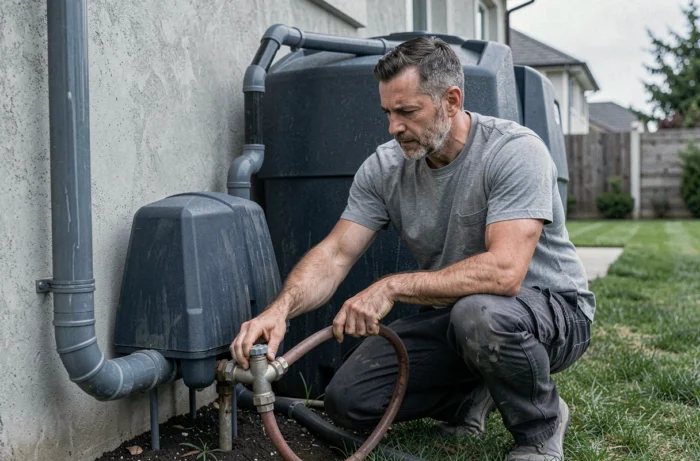
The physical separation between the rainwater network and the drinking water network is the most stringent obligation. A simple valve is not sufficient. The regulation requires a total disconnection to avoid any risk of backflow into the public network.
Points of withdrawal supplied by rainwater must be visibly identified. The installation must be declared at the town hall when connected to the internal network of the dwelling.
- Mandatory physical disconnection between the rainwater network and the drinking water network, no temporary connection or simple valve
- Visible identification of each point of withdrawal supplied by rainwater (pictogram “non-potable water”)
- Declaration at the town hall required for any installation connected to the internal network
Maintenance of the tank and storage quality: the parameters that really matter
Rather than setting an arbitrary duration, it is more effective to control the storage conditions. The quality of water in a recovery tank primarily depends on the condition of the container and the collection circuit.
The role of the filter and the first flush
A filtration system upstream of the tank retains leaves, insects, and coarse sediments. Some devices include a first flush separator, which diverts the first liters of a shower before the water enters the tank. This installation detail significantly alters the duration for which the water remains usable.
Opacity, temperature, and ventilation
An opaque buried tank keeps water in much more stable conditions than a translucent plastic above-ground collector. The absence of light slows down the photosynthesis of algae. The lower soil temperature slows bacterial proliferation.
An underground and opaque tank significantly extends the usable duration compared to an above-ground tank exposed to climatic variations.
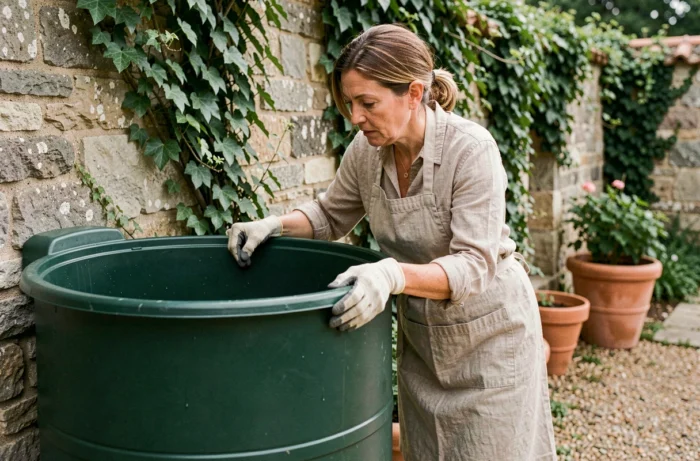
Annual cleaning of the bottom of the tank, where sediments accumulate, is a gesture often neglected. These deposits create a favorable environment for the development of anaerobic bacteria. A partial drainage followed by a high-pressure rinse, once a year, maintains the quality of storage over the long term.
Rainwater for the vegetable garden and laundry: two uses, two requirements
Watering the garden and vegetable patch represents the most common use of stored rainwater. For watering at the base of plants, the quality requirements remain moderate. Water stored for several weeks in a properly maintained tank is suitable without special treatment.
Washing laundry is a more demanding case. The 2024 decree allows it, but washing machine manufacturers have not designed their machines to operate with water whose bacterial load is variable.
Washing laundry with rainwater requires finer filtration than simple watering. Some sources recommend additional treatment (UV lamp or microfiltration) to limit the risks of textile contamination.
- Watering the vegetable garden: water stored under good conditions is suitable even after several weeks, provided the tank is opaque and cleaned regularly
- Washing floors and toilets: low quality requirement, the natural rotation of the reserve is generally sufficient
- Washing laundry: additional filtration recommended, available data do not allow conclusions about the effectiveness of simple prolonged storage without treatment
The shelf life of rainwater does not have a single answer. An underground, opaque tank equipped with a first flush separator and cleaned annually maintains usable water well beyond a few days. System maintenance and reserve rotation remain the two most reliable levers to extend the duration of use before each use.