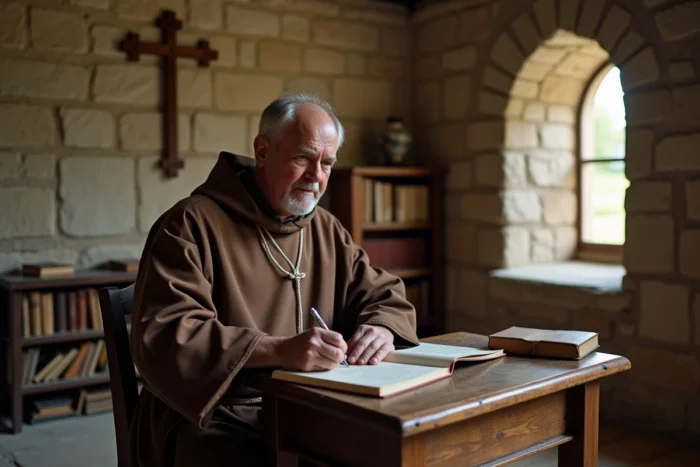
A Catholic monk in France does not receive a payslip. No salary statement, no monthly transfer in his name. The question of a monk’s salary often arises, but it is based on a misunderstanding: monastic life operates according to a radically different economic model than salaried employment. Understanding this model is key to grasping why discussing “remuneration” doesn’t really make sense here.
Vow of poverty and renunciation of individual property
Before delving into the numbers, a point of canon law deserves mention. By taking his vows, the Catholic monk renounces private ownership. In practical terms, he owns nothing personally: no personal bank account, no assets, no individual income.
This renunciation is not symbolic. It structures the entire economic life of the monastery. The income generated by the community (sales of products, hospitality, donations) feeds into a common budget that covers the needs of each monk: housing, food, clothing, medical care, social contributions.
An article detailing the salary of a Catholic monk helps clarify the financial mechanisms at play, even if the term “salary” remains technically inaccurate.
Thus, the monk does not receive personal remuneration in the sense of the Labor Code. He lives within a community that meets his material needs, based on a principle of complete mutualization.
Economic resources of a Catholic monastery in France
Where does the money that sustains a monastic community come from? The sources vary from one abbey to another, but three pillars are almost universally present.
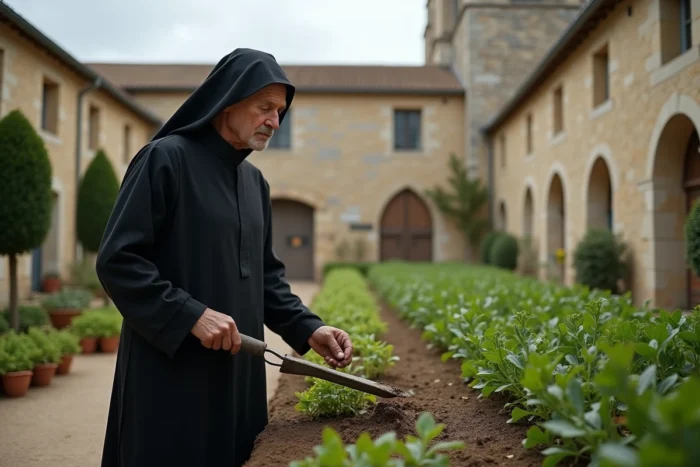
- The sale of monastic products: beers, cheeses, jams, candles, cosmetics. Some abbeys, like Sept-Fons, have developed a recognized artisanal activity that constitutes their main source of income.
- Hospitality and spiritual retreats: many monasteries host retreatants for a financial contribution. This often takes the form of a free donation adjusted to the visitor’s means, rather than a fixed fee.
- Donations and legacies: the generosity of the faithful and inheritances supplement the community budget, with amounts varying greatly depending on the monastery’s reputation and location.
Each community manages its own budget. Some abbeys live comfortably thanks to a well-structured economic activity. Others struggle to cover their expenses, especially when the community ages and the workforce becomes scarce.
Monk and diocesan priest: two distinct economic models
The confusion between monks and priests fuels many misunderstandings. A diocesan priest, the one you encounter in the parish, operates under a different system.
The diocesan priest receives a monthly living allowance paid by his diocese. The Conference of Bishops of France sets a reference amount. Priests also benefit from a residence (the presbytery) and sometimes from mass fees.
The monk, on the other hand, receives nothing individually. All resources flow through the community. Even when a monk engages in paid work outside (teaching, chaplaincy), the income is fully returned to the community.
This distinction explains why websites that display an “average monk’s salary” produce misleading figures. They apply a conventional salary scale to a reality that does not fit it.
The particular case of Alsace-Moselle
In Alsace and Moselle, the concordat regime maintains a system where some ministers of religion are paid by the state. This arrangement applies to priests, pastors, rabbis, and imams, but not to monks or religious living in community. A monk residing in an Alsatian abbey remains subject to the same community model as anywhere else in France.
Social protection and health coverage for monks in France
You might wonder: without a salary, how does a monk access social security? The question is legitimate, and the answer is less straightforward than it seems.
Religious communities contribute to the Retirement Insurance Fund for Religious, a specific scheme. The monastery covers the social contributions for each member. Thus, monks benefit from health coverage and retirement, even if they have never received a salary in the usual sense.
The retirement amounts remain modest, as they are calculated based on community contributions, not on individual income. A retired monk generally continues to live within his community, which meets his needs until the end.
Monastic life and the real economy: what the numbers don’t tell
Reducing a monk’s financial situation to a monthly amount misses the essential point. The monk pays no rent, no bills, and no food. His travel is limited. His personal material needs often amount to just a few items.
In terms of “disposable income,” a monk ultimately has little pocket money (a few dozen euros per month in most communities), but his basic needs are covered without exception. It is an economic model where the notion of individual purchasing power loses its relevance.
The real fragility is collective. When an abbey sees its numbers decline, the fixed costs remain: building maintenance, heating, compliance upgrades. Several French communities have had to leave their premises in recent years due to a lack of manpower and sufficient resources to maintain a viable site.
The actual salary of a Catholic monk in France is therefore zero in the strict sense. What exists is a system of complete support by the community, financed by collective work, donations, and the economic activity of the monastery. A model that holds as long as the community itself holds.