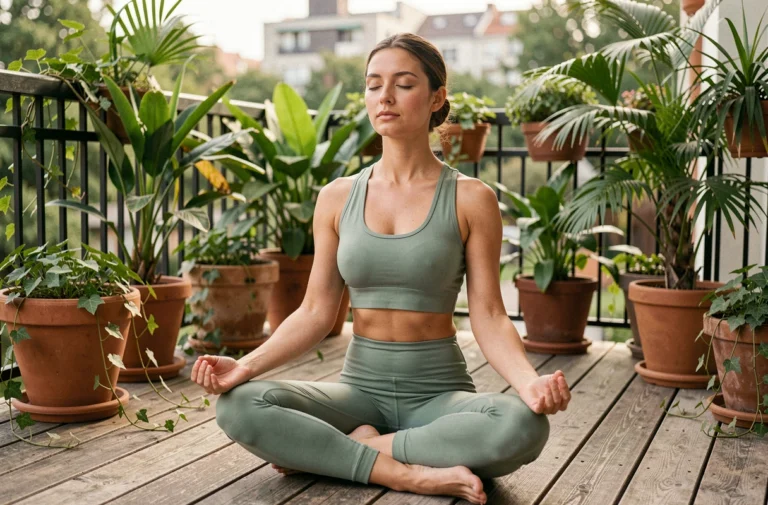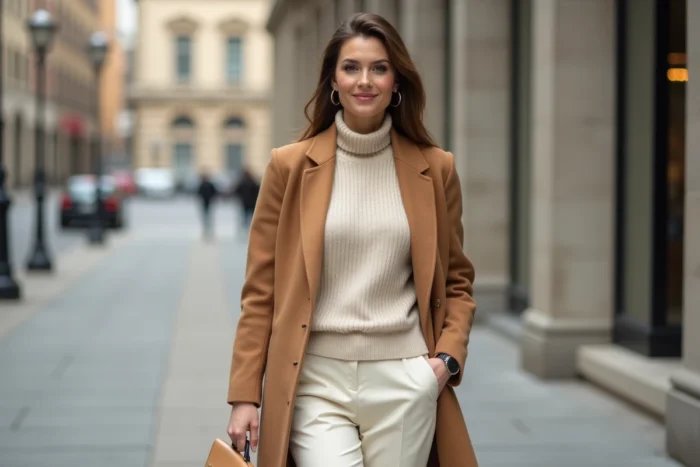
Open your wardrobe at 7:15 AM and assemble an outfit in under two minutes without risking a fashion faux pas: this is the promise of a well-calibrated minimalist palette. The problem is that many so-called streamlined wardrobes end up looking bland because the chosen colors do not take into account either the skin tone or the professional context. Building an effective minimalist wardrobe starts with selecting three to five colors that work well together and suit you.
Adapting your minimalist palette to your skin tone to avoid a dull effect
You can wear beige all week and look radiant, or appear exhausted by Monday. The difference lies in the undertone of the skin, not the color itself.
For warm undertones (greenish veins on the wrist, natural glow with gold near the face), warm neutrals like camel, brown, and golden beige serve as a reliable base. A camel pant, an ecru sweater, a cocoa brown jacket: you achieve a coherent minimalist look without the face fading behind the clothes.
For cool undertones (bluish veins, silver flatters more than gold), you shift towards muted gray, navy blue, and crisp white. These shades structure the silhouette and enhance the complexion instead of dulling it. Pure black also works, but only if worn close to the face with a fabric that catches a bit of light.
A detailed guide on minimalist colors on Ou pas elaborates on this logic of matching skin tone and wardrobe palette.
The operational rule: choose one dominant color, one or two secondary colors, and a subtle accent. The dominant color represents the majority of the pieces (bottoms, coats, basics). The secondary colors complement (shirts, knits). The accent, used sparingly (a scarf, a belt, a bag), adds depth without breaking the simplicity.

Neutral colors at the office: choose based on the actual dress code
Dress minimalism is not practiced the same way in a law firm and in a design agency. No matter how often it is said that black works everywhere, a total black look in a bright open space with colleagues in vibrant colors results in an austere, not elegant, appearance.
Formal environment
In a strict setting (finance, legal, consulting), the most functional palette revolves around navy blue, charcoal gray, and white. These three colors combine effortlessly. A sober beige or deep burgundy can be added as an accent to avoid monotony.
Creative or casual environment
When the dress code is flexible, you can replace the classics with “faux color” neutrals like muted blue, sage green, or light cocoa brown. These shades function just like beige in terms of versatility but add more personality. Sage green pants with a white tee and a greige blazer: the look remains minimalist, the palette stays short, and the result stands out from the all-black-white-beige we see everywhere.
Feedback varies on this point, but sage green and muted blue seem to work better on cool to neutral skin tones, while light cocoa brown pairs well with warm skin tones.
Clothing maintenance and color choice: the forgotten criterion
Maintenance is rarely discussed when talking about minimalist style. Yet, it is a decisive filter. A poorly thought-out color palette in relation to one’s lifestyle ends up in dry cleaning chores or faded clothes after three months.
- Pure white looks beautiful in photos, but it requires separate washing, frequent stain removal, and ages quickly if you wear your basics in tight rotation. Prefer an off-white or ecru, which is more forgiving.
- Black attracts lint, shows hard water marks after washing, and loses its depth after a few dozen cycles. A good quality black fabric will space out disappointments, but you need to budget for higher quality material.
- Medium shades (medium gray, beige, camel, muted blue) are the easiest to maintain daily: they better conceal micro-stains, can be washed together, and retain their color integrity longer.
- Dark accent colors (burgundy, navy blue, forest green) hold up well to repeated washes and provide contrast without the constraints of black or white.
In practice, if you want a minimalist wardrobe that operates with few pieces, building the foundation on medium shades reduces maintenance time and extends the lifespan of each garment.
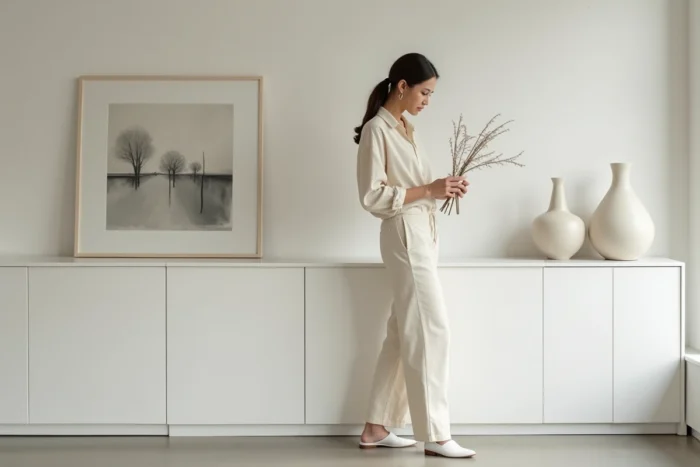
Building your minimalist palette in three concrete steps
Rather than an abstract list of “trendy colors,” here’s a method to determine your own base colors.
First step: identify your undertone. Take a pure white t-shirt and an ecru t-shirt, hold them one after the other near your face in natural light. The one that makes you look better indicates the direction (cool for pure white, warm for ecru).
Second step: select one dominant and two secondary colors from the neutrals that match your undertone. Aim for pieces that exist in common basics (pants, t-shirts, sweaters) for easy restocking.
Third step: choose an accent. One color is enough to break the monotony of a streamlined wardrobe. A soft rust, a burgundy, a subtle cobalt blue. The accent should never exceed one piece per outfit.
The resulting palette (three to five colors) then covers almost all possible combinations for everyday wear. Each morning, any piece from the wardrobe can be combined with any other without hesitation.
Fashion minimalism benefits from being treated as a practical tool, not as an aesthetic stance. A short palette, adjusted to your skin tone and compatible with your maintenance rhythm, transforms a reduced wardrobe into a reliable system. Style comes from coherence, not from the number of pieces.