
A refrigerated truck parked at a delivery dock in the middle of summer, engine off, refrigeration unit stopped for an hour: the internal temperature of the cargo area rises much faster than one might imagine. Between deliveries, during a lunch break, or in the event of an unexpected breakdown, it is when stationary that the cold chain is most vulnerable.
Power supply for the refrigeration unit at rest: the often-overlooked link
On the road, the refrigeration unit operates thanks to the vehicle’s engine or its own diesel engine. As soon as the truck comes to a stop, the question of power supply for the refrigeration unit becomes central. Without a power source, the temperature in the cargo area can drift, sometimes in just a few minutes during high heat.
Several approaches exist to meet this need. Refrigerated containers used in maritime logistics systematically come with dedicated generators, a logic that is increasingly being applied to trucks and trailers. To find solutions for a refrigerated truck at rest, one can look towards compact onboard generators, shore power connections, or lithium-ion backup batteries.
The market also offers systems capable of running the compressor for several hours without being connected to the grid, which is particularly suitable for urban distribution or nighttime deliveries.
The choice depends on the usage profile. A vehicle that parks every night at the depot benefits from being connected to shore power. A truck that makes frequent stops in urban areas without access to the grid needs an autonomous battery or a small generator more. Feedback on this point varies depending on the size of the refrigeration unit and the insulation of the cargo area, but the principle remains the same: plan for a dedicated power source before stopping, not after.
Parking and thermal inputs: what the location really changes
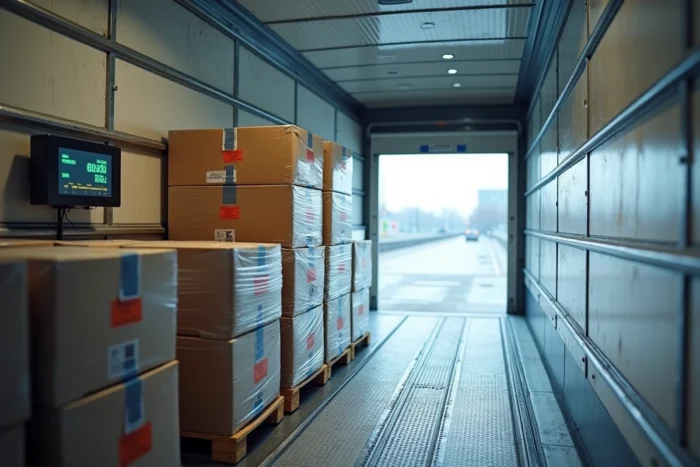
The direct environment’s impact on the refrigeration performance of a stationary vehicle is often underestimated. The truck’s orientation, sun exposure, and ventilation around the cargo area significantly alter the thermal load that the refrigeration unit must compensate for.
Exhaust grilles and exposed walls
The external grilles of the refrigeration unit (condenser) must expel heat. If they are in direct sunlight or against a wall, efficiency drops. Temperature stability can be improved simply by positioning the truck so that the condenser remains shaded and unobstructed.
The same reasoning applies to the side walls. A white truck parked in direct sunlight on an asphalt parking lot accumulates heat through radiation. Parking under a canopy, in the shade of a building, or orienting the cargo area to limit the exposed surface are simple actions that reduce the unit’s overconsumption and slow down the temperature rise if the cooling is turned off.
Door openings and dock discipline
Each opening of the rear door causes a massive exchange of air. On a non-refrigerated loading dock, warm air enters from the top while cold air escapes from the bottom. This phenomenon can be limited with strip curtains or dock seals, but the most effective rule remains to reduce the duration and frequency of openings.
In practice, this means organizing loading in batches, preparing pallets before opening, and never leaving doors open “waiting.” It is a matter of operational discipline as much as equipment.
Continuous temperature monitoring: recorders and alerts
A refrigeration unit running does not guarantee the maintenance of the cold chain by itself. A poorly placed probe, an offset thermostat, or a worn door seal can create an invisible temperature deviation without reliable measurement instruments.
Onboard temperature recorders (dataloggers) have become a regulatory standard for temperature-controlled transport. Their role is not limited to compliance: they allow for detecting a drift before it becomes critical. Recent models send real-time alerts via SMS or through a cloud platform when a threshold is crossed.
- Place probes in several locations within the cargo area (front, back, top, bottom) to identify hot zones, especially near the doors
- Regularly check the calibration of sensors, as a sensor drifting by a few degrees can skew the entire control chain
- Keep timestamped records for each trip and each prolonged stop, which serves as proof of compliance in case of health inspections
A well-configured alert system provides time to react: restart the unit, connect a backup power source, or transfer the goods before the products are compromised.

Preventive maintenance of the refrigeration unit: anticipate rather than suffer
The majority of refrigeration unit failures at rest are related to maintenance issues that could have been detected in advance. A fatigued compressor, an undercharged refrigerant circuit, or a clogged condenser do not fail overnight: they gradually lose performance.
- Check the refrigerant level and the condition of the compressor according to the manufacturer’s recommendations
- Clean the condenser and evaporator, especially during periods of high heat where dust and plant debris accumulate quickly
- Check the seals of doors and cable passages for leaks, as even a small air leak forces the unit to run in overload
- Test the switch to backup power (battery or shore power) before needing it in a real situation
A well-maintained unit consumes less and maintains temperature longer in case of a power cut. Conversely, neglected equipment can lose its ability to compensate for thermal inputs well before it fails completely.
Pre-cooling the cargo area before loading is also part of operational maintenance. Loading sensitive products into a still-warm cargo area means asking the refrigeration unit to compensate for a deviation that could have been avoided. It is recommended to start the unit well in advance so that the cargo area reaches the target temperature before any loading.
Preserving the cold chain on a refrigerated truck at rest relies less on a miracle equipment than on a combination of concrete choices: a backup power supply suited to the usage profile, thoughtful parking, active temperature monitoring, and regular maintenance of the unit. Each of these levers, taken individually, seems modest. Combined, they make the difference between compliant goods and a lost batch.