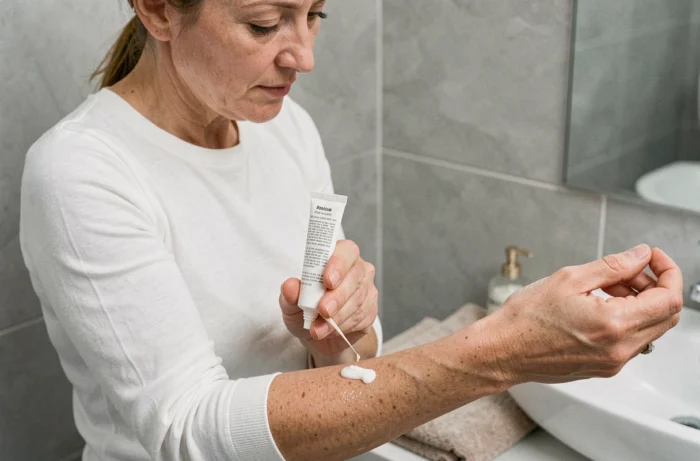
When you first open a single-dose capsule of Sterdex, the thick texture of the ointment is surprising. This is not a liquid eye drop: the greasy consistency requires a precise action to reach the right spot without contaminating the product or irritating the eye. This ophthalmic ointment combines a corticosteroid (dexamethasone) and an antibiotic (oxytetracycline), prescribed especially after ophthalmic surgery or for certain eye infections with an inflammatory component.
Risk of masking an eye infection with Sterdex
Let’s start with the point that most online content glosses over. The corticosteroid-antibiotic combination in Sterdex can alleviate the symptoms of an infection without curing it. Dexamethasone reduces inflammation, redness, and pain. The result: you feel better, but the responsible germ may continue to grow.
This is why this medication is only available by prescription. Using it without a precise diagnosis muddles the signals the eye sends. A viral infection (such as ocular herpes) is, moreover, a formal contraindication: the corticosteroid would worsen the situation instead of resolving it.
Specifically, if you have a leftover capsule of Sterdex from a previous treatment, do not reuse it for a new episode of redness or swelling. Knowing how to apply Sterdex ointment starts with this rule: each prescription corresponds to a given diagnosis, not to a recurring symptom that one treats oneself.

Technique for applying Sterdex ophthalmic ointment
The official instructions indicate to place the ointment in the lower conjunctival sac, which is the small groove between the lower eyelid and the eyeball. In practice, this action requires a bit of method.
Preparing the single-dose capsule
Wash your hands with soap. This is the most underestimated action: a poorly washed hand can introduce bacteria directly into the eye. Then take a clean pair of scissors and cut the tapered end of the capsule. Do not tear the capsule with your teeth or nails, as the cut would be uneven and you risk splattering ointment elsewhere.
Placing the ointment in the right spot
- Lean your head slightly back, in front of a mirror if possible, to see what you are doing clearly.
- Pull the lower eyelid down with a clean finger while looking up, which clears the conjunctival sac.
- Gently squeeze the capsule to release a small ribbon of ointment into the groove thus formed, without touching the eye or eyelashes with the tip.
- Close your eye slowly (no sudden blinking) and allow the ointment to spread for a few seconds.
After application, vision may temporarily blur due to the greasy texture. This is normal. It is better to plan the application for the evening or at a time when you do not need to drive.
Frequency and duration of treatment
The usual dosage is one to three applications per day, depending on the prescription. Do not extend the treatment beyond the duration set by the doctor. An ophthalmic corticosteroid used for too long can lead to increased intraocular pressure or a fungal superinfection.
If symptoms persist or worsen after a few days, you should consult again. Feedback varies on this point, but the rule remains clear: no rapid improvement, no blind continuation.
Common mistakes with Sterdex and ophthalmic ointments
Some mistakes occur systematically, compromising both the effectiveness of the treatment and comfort.
Applying the ointment all around the eye is a common confusion. Sterdex is a local ophthalmic treatment: it is deposited in the eye (conjunctival sac) and possibly on the free edge of the eyelid if the doctor requests it. Spreading the ointment on the skin around the eye has no therapeutic value and wastes the product.
Another mistake: touching the tip of the capsule with fingers or placing it on a surface. The sterility of the contents is compromised as soon as there is contact. Each single-dose capsule is designed for one-time use. Never keep an opened capsule for later application.
Finally, some people apply eye drops just before the ointment. If you have multiple eye treatments, the eye drops should go on first. Wait a few minutes before applying Sterdex ointment; otherwise, the greasy layer prevents the absorption of the eye drops.
Sterdex in children and during breastfeeding: restrictions to know
This medication is reserved for adults and children over eight years old. This age limit is due to the systemic passage of oxytetracycline, which can cause permanent discoloration of teeth in young children. For a child under eight with an eye infection, the doctor will refer to another specialty.
During pregnancy and breastfeeding, the use of Sterdex requires explicit medical advice. The corticosteroid and the antibiotic enter the general circulation, even in low doses via the ophthalmic route. The instructions remind that the benefit-risk ratio must be evaluated on a case-by-case basis.
One last practical point: if you wear contact lenses, remove them before application and wait until the end of treatment to put them back on. The greasy ointment adheres to the lenses, alters their surface, and creates an environment conducive to bacteria. A well-conducted treatment with Sterdex rarely lasts more than a few days, just long enough to restore a healthy eye before resuming your lenses.