
A kitchen cluttered with unused gadgets is a sign that one has chosen their equipment on a whim rather than based on real needs. Selecting kitchen utensils and appliances wisely involves some concrete considerations, starting with what we actually cook, the available space, and the ease of cleaning each item.
Maintenance and cleaning: the criterion that is often underestimated at purchase
We look at the price, the design, sometimes the material. Rarely the ease of cleaning. Yet, this criterion determines whether a utensil stays in rotation or ends up at the back of the cupboard.
An appliance whose parts can be disassembled without tools and whose interior surfaces are smooth, without corners, can be cleaned in a few minutes. In contrast, a multifunction robot with hard-to-reach seals or embedded blades discourages regular use. Rounded angles and removable parts significantly reduce dirt buildup over time.
Before buying, one can ask a simple question: am I willing to wash this item after every meal? If the answer is no, it’s better to move on to the next one. Detailed resources can be found on kitchen equipment on Conseils Cuisine to compare models on this specific point.
Pans, pots, and Dutch ovens: choosing the right cooking materials
Cooking is at the heart of kitchen activity. The choice of material for your pans and pots directly influences the result on the plate, as well as the longevity of your cookware.
Stainless steel 304 vs. stainless steel 430: a concrete difference
Not all stainless steels are equal. Stainless steel 304 is significantly more resistant to corrosion than stainless steel 430, especially in a humid environment or when in contact with acidic foods like tomato sauce or vinegar. On a pot used daily, this difference translates into a longer lifespan and a cleaner appearance.
Favoring stainless steel 304 for everyday cooking utensils avoids unpleasant surprises after a few months. Stainless steel 430 is more suitable for less frequently used items, such as storage bins.

Cast iron, ceramic, and non-stick: for what uses
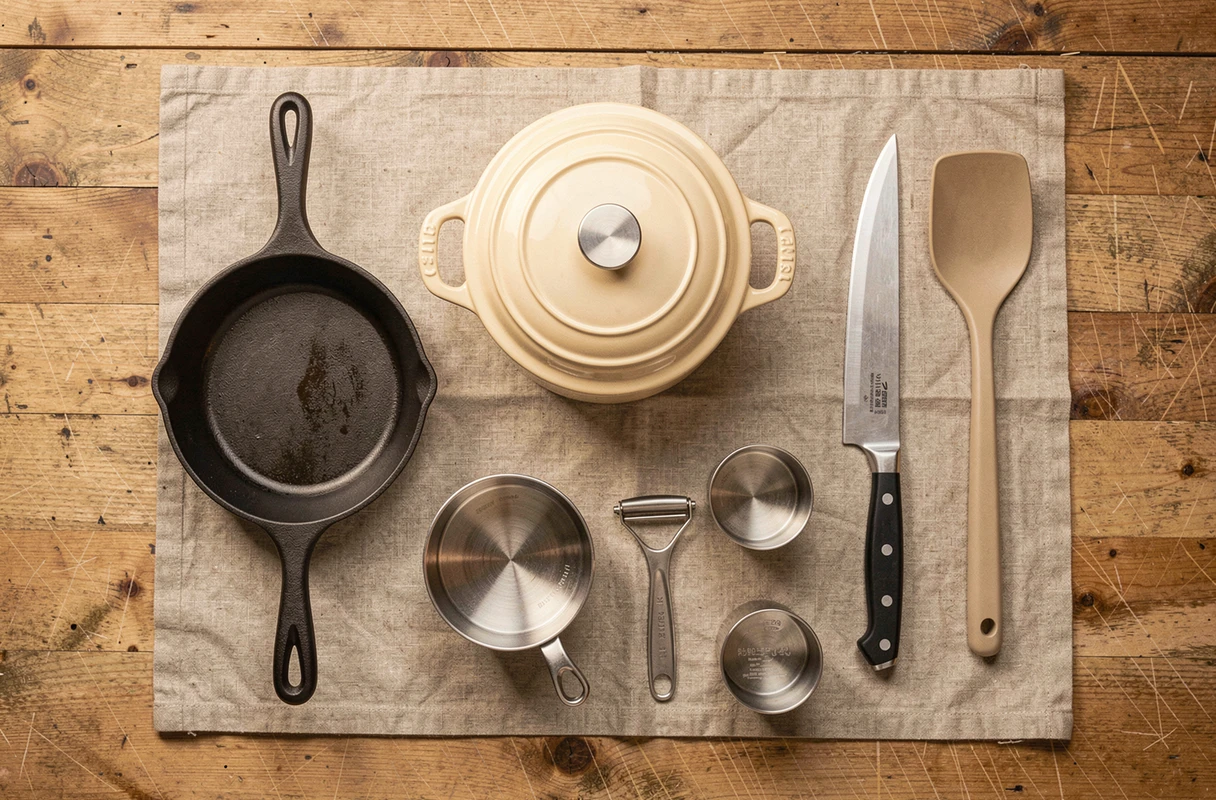
The cast iron Dutch oven excels for slow-cooked dishes and long cooking times. Its thermal mass regulates heat and tolerates temperature fluctuations. However, its weight makes it impractical for quick daily use.
Ceramic or non-stick pans are better suited for short cooking: eggs, sautéed vegetables, pancakes. Their limitation is the durability of the coating. A non-stick surface loses effectiveness long before the pan itself is unusable.
- Enamelled cast iron: ideal for stews, braises, and bread. Heavy, it requires suitable storage.
- Thick-bottomed stainless steel 304: versatile, compatible with all heat sources, including induction. Dishwasher safe without degrading.
- Ceramic or non-stick: perfect for delicate cooking over medium heat, but needs to be replaced regularly as the coating wears out.
Everyday kitchen equipment: avoiding over-equipping
The natural reflex when setting up or rearranging a kitchen is to want to cover everything. Raclette machine, pasta maker, juicer, Japanese mandoline. Each purchase seems justified at the moment. The reality is that most of these appliances are used less than five times a year.
Sizing your equipment based on your actual cooking frequency helps save space and money. Start by identifying what you prepare each week: if you never make fresh juice, the juicer has no place on the countertop.
The three-week rule
Before buying a new accessory, one can ask: would I have used it at least three times in the last three weeks? If the answer is no, it’s probably an impulse purchase. This simple approach filters out most unnecessary gadgets.
Opinions vary on this point, as some seasonal equipment (griddle, fondue maker) justifies concentrated use over a few months. The idea is not to deprive oneself, but to distinguish essentials from occasional accessories.
Compatibility with space and existing installation
High-performing equipment that is too large for the countertop, or incompatible with the existing cooktop, becomes a problem rather than a solution. Compatibility with the existing installation is a selection criterion just as important as material or price.
- Check the overall dimensions of each appliance, including the necessary clearances for opening doors or lids.
- Ensure compatibility with the heat source: not all pans and pots work on induction.
- Make sure the planned storage (drawer, cupboard, shelf) accommodates the height and weight of the utensil, especially for cast iron.
Measuring before buying avoids returns and utensils that clutter. A tape measure in the kitchen is more useful than a product sheet skimmed through.
The right kitchen equipment is what you take out every day without hesitation, clean effortlessly, and store without struggle. Everything else deserves to be reconsidered before checkout.