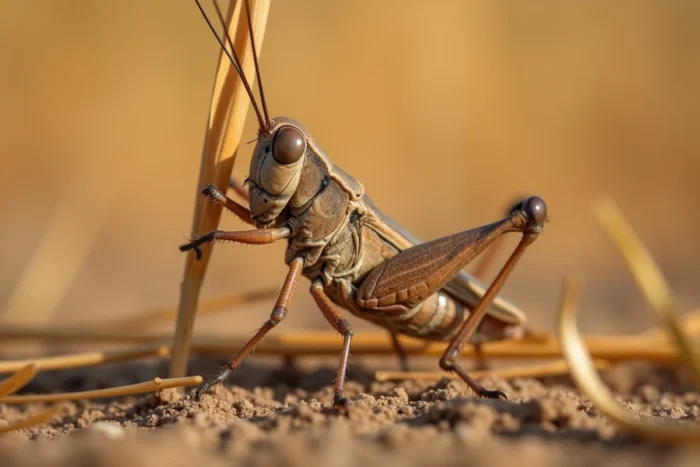
In orthopterans, the color of an individual is not enough to determine its species or stage of development. A grasshopper observed in brown may belong to a species that is usually green but is going through a post-molt phase where its chromatophores have not yet stabilized their final pigmentation. This chromatic plasticity blurs the usual markers and makes reading the life cycle more complex than it seems.
Chromatic plasticity and molts: why the brown grasshopper is not always brown
Most articles dedicated to grasshoppers present color as a fixed characteristic linked to the species. The physiological reality is different. The brown hue can be transient, related to the redistribution of pigment cells (chromatophores) during and after each molt.
Specifically, a green nymph in the previous stage may appear brown or reddish a few hours after leaving its exuviae. The coloration then stabilizes, sometimes in a few days, sometimes only at the next stage. This phenomenon, well documented in other arthropods, is starting to be used to interpret intra-seasonal color variations in terrestrial insects.
To understand the life cycle of the brown grasshopper, it is essential to integrate this data: a brown individual observed in a garden is not necessarily a brown species, but potentially a green grasshopper in chromatic transition.
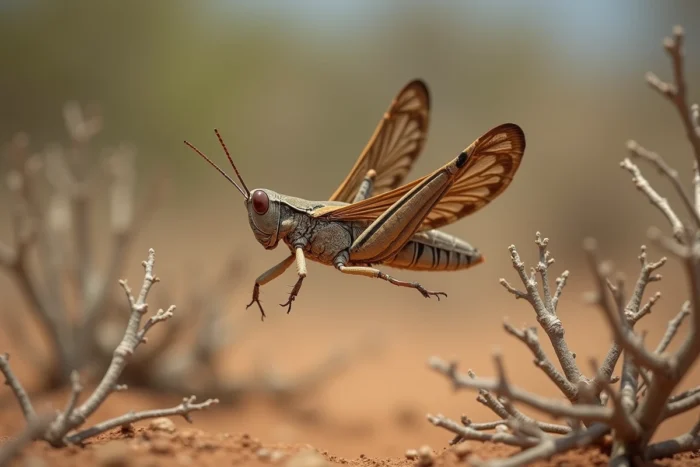
Environmental factors also play a role. Vegetation density, sun exposure, and humidity levels influence pigment production. A population living in a dry, open environment will tend to have more brown individuals than a population of the same taxon located in a humid forest edge.
Incomplete metamorphosis of the grasshopper: comparative table of stages
Grasshoppers undergo a so-called incomplete metamorphosis (hemimetabolism). Unlike butterflies or beetles, there is no immobile nymphal stage or chrysalis. The juvenile resembles the adult from hatching, in miniature form and without functional wings.
| Stage | Indicative Duration | Morphological Characteristics | Flight Ability |
|---|---|---|---|
| Egg | Several months (frequent hibernation) | Buried in the soil, protected by an ootheca | None |
| Nymph (stages I to V-VI) | Several weeks to several months depending on the species | Progressive wing buds, successive molts | None (non-functional buds) |
| Adult (imago) | Several weeks to several months | Complete wings, mature reproductive organs | Yes (depending on the species) |
This table highlights a often underestimated point: the nymphal phase concentrates the majority of growth. Each molt (between five and six depending on the species) increases body size and advances wing buds. It is also during these molts that coloration can temporarily turn brown.
Differences between nymphs and adults in the field
In field observation, the distinction relies on the wings. A last-stage nymph has well-visible but folded wing buds that do not extend beyond the abdomen. The adult, after the imaginal molt, deploys complete wings that cover or exceed the abdominal tip.
The antennae constitute another criterion. In grasshoppers (suborder Ensifera), they are always longer than the body, distinguishing them from crickets (Caelifera) whose antennae remain short. This characteristic is stable from the first nymphal stage to the adult.
Locomotor behavior of nymphs: an overlooked angle of the life cycle
Juvenile stages, unable to fly, do not move like adults. Recent work in behavioral ecology shows that nymphs use distinct locomotor strategies to compensate for the lack of flight.
- First-stage nymphs primarily move by short hops and remain within a limited perimeter around the hatching site, limiting their exposure to predators
- Advanced-stage nymphs (IV-V) cover greater distances by walking along stems, exploiting the verticality of vegetation rather than horizontal movement
- The winged adult combines flight, walking, and jumping to colonize new habitats, significantly increasing its range compared to juveniles
This difference in mobility has direct consequences on vulnerability to predators. A nymph confined to a patch of low vegetation will be more exposed to insectivorous birds than an adult capable of fleeing in flight. Predation pressure thus varies throughout the life cycle, a parameter rarely mentioned in classical descriptions.

Egg laying and hibernation of grasshopper eggs: the discreet link in the cycle
The female deposits her eggs in the soil using her ovipositor (sword-shaped laying organ, characteristic of Ensifera). The eggs are grouped in a protective structure called an ootheca, buried a few centimeters deep.
The hibernation of the eggs constitutes the longest stage of the cycle. In temperate regions, eggs laid in late summer remain in diapause throughout the winter. Hatching occurs the following spring when the soil temperature reaches a sufficient threshold.
This delay between laying and hatching explains why adult grasshoppers disappear in autumn without the species locally going extinct. The population survives in the form of buried, invisible eggs protected from frost by the layer of soil.
Factors influencing hatching success
- Soil moisture: a substrate that is too dry can dehydrate the eggs before spring hatching
- Tillage or soil turning: mechanized agricultural practices destroy oothecae buried in the first centimeters
- Underground predation: some beetles and nematodes parasitize the eggs during winter
The combination of these factors determines the annual recruitment rate of a local population. A cold, dry spring following an intensive tillage winter significantly reduces the number of emerging nymphs.
The brown grasshopper, whether its color is due to its species or to a transitional post-molt phase, thus goes through a cycle structured by three constraints: the winter survival of buried eggs, the vulnerable growth of wingless nymphs, and the brief reproductive window of the winged adult. Each stage imposes different ecological pressures, making this insect a good indicator of the health of grassland environments.