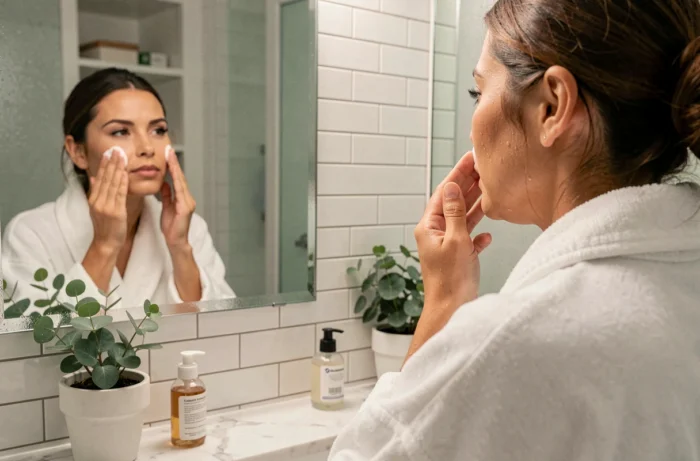
Applying moisturizer every morning, drinking a large glass of water when you wake up, removing your makeup before bed: these beauty and wellness habits feature in every list of advice. They may seem universal, but how well they work depends on your skin type, your budget and how much time you actually have. Some routines touted as simple can even irritate sensitive skin or add unnecessary steps to your day.
Daily facial care: tailor your routine to your skin
Have you ever noticed that a product everyone raves about leaves your skin feeling dry or causes redness? It’s no coincidence. Oily, dry and combination skin can react very differently to the same cleanser or serum.
The first useful step is to identify your skin type before buying anything. A consultation with a dermatologist or a simple test at a pharmacy is all it takes. From there, choosing skincare becomes a logical process rather than an impulse purchase.
For cleansing your face, a gentle, soap-free product works for most skin types. Strong foaming cleansers may feel satisfying to use, but over time they can weaken the skin barrier. Micellar water, often presented as a basic essential, can also leave a residue if you don’t rinse it off. A seemingly simple step that, when done incorrectly, can cause more problems than it solves.
Moisturizing remains the most useful daily skincare step. Applying a suitable cream to slightly damp skin helps lock in moisture. Layering serums, oils and masks won’t do any more if your basics are right. Two well-chosen products are better than six that aren’t right for you.
For more information and tailored advice on beauty routines, visit this useful resource: https://www.lebreakbeaute.fr.

Wellness routines on a budget: what really works
The wellness industry encourages us to spend: scented candles, dietary supplements, massage tools, ritual kits. Many of these products offer a little short-term pleasure, but their actual impact on health is limited. The risk is confusing spending money with self-care.
Habits that have a measurable effect on your body often cost nothing:
- Getting seven to nine hours of sleep a night helps your skin regenerate and visibly reduces dark circles and dullness
- Walking for around 30 minutes a day improves blood circulation, resulting in a brighter complexion and more elastic skin
- Cutting back on refined sugar and alcohol reduces skin inflammation, including adult acne
Sleep is the cheapest and most effective anti-aging treatment. No cream can make up for the effects of chronic sleep deprivation on your face.
When it comes to relaxation, a few minutes of deep breathing or stretching in the morning can be a better alternative to an expensive meditation app subscription. Daily well-being depends more on sticking to a simple habit than on accumulating products.
Body care: distinguish essentials from extras
Body care follows the same principles as facial care. The essential step is moisturizing after a shower, while your skin is still slightly damp. A basic body lotion costing just a few euros works as well as a €30 body butter, as long as drying alcohol isn’t one of the first ingredients on the list.
Reading a product’s INCI ingredient list takes 30 seconds and can save you from costly mistakes. The first three ingredients make up most of the formula. If the active ingredient highlighted on the packaging appears near the end of the list, its concentration is negligible.
Body scrubs: how often to use them
Exfoliating removes dead skin cells and helps your skin absorb moisturizer. Once a week is enough for most skin types. Exfoliating more often can irritate the skin and trigger increased oil production in response, producing the opposite of the desired effect.
For sensitive or reactive skin, a soft washcloth used with a moisturizing soap provides gentle physical exfoliation without the need to buy an extra product. Adjusting how often and how intensely you exfoliate to suit your skin’s tolerance is the most reliable rule to follow.

Beauty rituals and lifestyle: build a routine you can stick to
Why do some routines last two weeks and then disappear? Often because they take too much time or involve too many steps. An effective long-term beauty routine takes five minutes in the morning and five minutes at night—no more.
Here’s a practical guide to structuring your daily routine:
- Morning: wash your face with water or a gentle cleanser, apply moisturizer, and use sun protection if needed
- Evening: remove your makeup or cleanse your face, then apply a targeted treatment if needed (for acne, dryness or dark spots)
- Once a week: alternate between gentle exfoliation and a hydrating mask
A routine you follow every day is better than an elaborate one you only stick to now and then. The goal isn’t to copy a routine you saw online, but to choose habits that fit your own needs and constraints.
If your skin can’t tolerate popular ingredients such as retinol, fruit acids or concentrated vitamin C, there’s no reason to use them just because they’re trending. Every skin type has its limits, and respecting them is part of good skincare.
Taking care of yourself every day doesn’t require a big budget or a bathroom full of bottles. The most effective habits are often the simplest: get enough sleep, moisturize your skin with a product that suits it, and protect your face from the sun. Everything else is optional—and that’s good news.