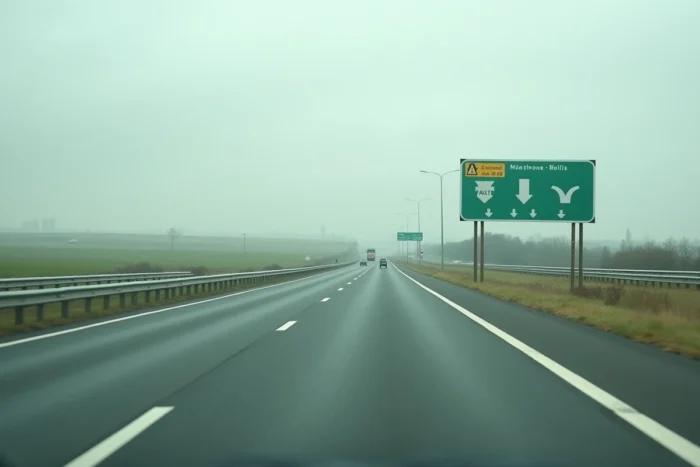
The French motorway network will not experience a massive shift to free access in 2026. Private concessions remain in place, toll rates are increasing, and the changes mainly concern the methods of collection and tariff adjustments. The real question is about motorists’ behavior in response to these developments and the consequences for national and departmental roads.
Traffic diversion to national roads: the real change in the road network in 2026
The successive increases in toll rates are pushing a growing number of motorists to leave paid motorways in favor of national and departmental roads. This phenomenon of traffic diversion to alternative routes represents the most concrete change for the so-called free network in 2026.
The consequences of this shift go beyond simply extending travel times. The municipalities crossed by national roads are experiencing an increase in the flow of heavy goods vehicles and light vehicles, with direct effects on road safety, noise, and pavement wear.
Several factors worsen the situation for the affected communities. A detailed overview of the developments in the motorway network on Pulsion Laval allows for measuring the extent of these traffic transfers.
- Two-lane national roads are absorbing traffic for which they were not designed, multiplying congestion points during peak hours
- The crossings of towns and small cities are seeing an increase in vehicle passage, impacting the quality of life for residents and local accident rates
- The maintenance of these roads falls under the departments or the State, whose budgets do not keep pace with the increased usage caused by the motorway diversion
Toll increase 2026: disparities among concessionaires
The average increase in toll rates on February 1, 2026, is set at 0.86%, presented as the lowest since 2021. This overall figure masks very different realities depending on the concessionaire and the route taken.
The French motorway network is operated by several private concession companies: VINCI Autoroutes (ASF, Cofiroute, Escota), APRR/AREA, and Sanef/SAPN. Each applies its own pricing schedules within the framework set by the State. The actual impact on a motorist’s budget therefore depends on their usual route, not the national average.
For a daily commuter, even a modest percentage increase translates into a significant annual cost. It is precisely this accumulation that fuels the shift to free roads, especially for short and medium-distance home-to-work trips.
Why the national average does not reflect your route
A motorist using a section managed by ATMB in Savoie does not experience the same tariff evolution as a user of the A10 between Paris and Bordeaux. The concession contracts, negotiated at different times, incorporate indexing mechanisms specific to each network.
Comparing rates between concessionaires before planning regular trips is becoming a habit for motorists keen on managing their budget. The disparities can justify a change of route, even while remaining on the paid network.
Free-flow tolling: deployment and practical consequences
The free-flow tolling system continues to be deployed across the French network. This system removes physical toll barriers: vehicles pass under gantries equipped with sensors and infrared cameras, without slowing down or stopping.
Payment is automatic for holders of a toll badge. Other users have a grace period to pay online or by other means. This system, already operational on certain sections since late 2022, is gradually expanding.
What free-flow changes for occasional motorists
The removal of toll barriers alters the perception of motorway costs. Without a physical stop or immediate payment, the cost of the trip becomes less visible at the moment of decision. For occasional or foreign drivers, the risk of receiving an inflated bill due to late payment increases.
The system favors toll badge holders, for whom passage is seamless. Others must anticipate payment to avoid penalties. This distinction creates a form of access inequality based on the vehicle’s equipment level.
- Users equipped with a toll badge do not change their habits, as the deduction is automatic
- Motorists without a badge must identify the payment site of the relevant concessionaire and pay within a variable timeframe depending on the operator
- Foreign or rental vehicles face payment procedures that are often poorly signposted, leading to disputes
Free motorways in 2026: no new sections planned
No significant extension of the free motorway network is scheduled for 2026. Most existing concessions run until the 2030s or beyond. The end of concessions remains the only mechanism that could make sections free, and no major deadlines fall this year.
The confusion between “barrier-free motorway” and “free motorway” persists in public debate. Free-flow tolling removes barriers, not payment. A free-flow motorway remains toll-based; only the method of collection changes.
Renationalization of motorways: where does the debate stand
The question of the early buyback of concessions regularly resurfaces in political debate. The cost of such an operation would amount to tens of billions of euros, and there is no guarantee that free access would follow a renationalization. Maintaining the network requires sustainable funding, whether through tolls, taxes, or a combination of both.
Motorists hoping for an imminent free access to French motorways may be disappointed. The most likely scenario for the coming years remains a continuation of regulated toll increases, an expansion of free-flow systems, and a gradual diversion of traffic to existing free roads, along with the tensions this generates on local infrastructures and the safety of the municipalities traversed.