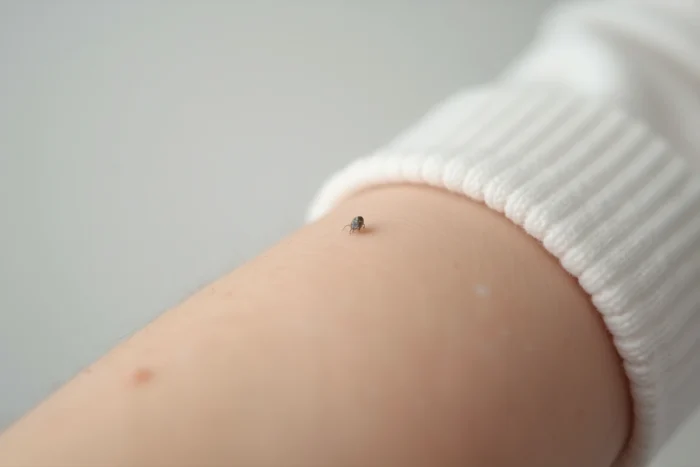
Several species of arthropods measuring barely one to two millimeters can land on the skin without being identified. Their black color and small size complicate observation, but distinguishing between these organisms determines the course of action: some cause only temporary discomfort, while others trigger skin reactions that warrant medical advice.
Skin irritation or bite: the difference changes everything
Most tiny black insects found on the skin do not bite in the strict sense. Thrips, for example, belong to the order Thysanoptera and feed on plant sap, not blood. However, their mouthparts can scratch the superficial layer of the epidermis when they land, triggering a tingling sensation.
This mechanical irritation is often confused with a bite from a blood-feeding insect. The distinction is practically important: contact irritation disappears within a few hours without treatment, while a true bite (such as from a parasitic mite) can cause localized swelling, persistent itching, or even a secondary infection if the area is scratched.
When a tiny black creature on the skin leaves a red mark that persists for more than twenty-four hours or spreads, the reaction goes beyond mere inconvenience. This is the first useful sorting criterion before any other steps are taken.

Thrips, mites, black aphids: identifying the species on the skin
Online content frequently mixes thrips, aphids, scale insects, and mites under the generic label of “small black insect.” However, the level of nuisance and the measures to be taken differ according to the species.
Thrips (storm bugs)
Thrips measure between one and two millimeters, display a color ranging from yellow to dark brown, and have fringed wings. Their presence on the skin is favored by episodes of heat and intense activity around host plants. They are pollinating insects that accidentally end up on arms or necks, attracted by sweat or light-colored clothing.
Their “bite” is actually a micro-scratching of the surface. The discomfort is real but without medical consequences in the vast majority of cases.
Parasitic mites (Dermanyssoidea)
Mites from the Dermanyssoidea group do actually bite to feed on blood or lymph. They are smaller than thrips, often invisible to the naked eye, and leave grouped lesions on areas covered by clothing. Confusion with bed bugs is common, but mites from this group often live in bird nests close to homes.
Black aphids and scale insects
These insects sometimes land on the skin outdoors but do not bite humans. They cause neither irritation nor allergic reaction. Their presence rather indicates an infestation on nearby plants.
- Thrips: mild mechanical irritation, spontaneous disappearance within a few hours, no treatment necessary
- Dermanyssoidea mites: real bite with persistent itching, grouped lesions, source to be sought in the home
- Aphids and scale insects: no risk to the skin, nuisance limited to plants
When to consult a doctor for a bite from a small black insect
The question of the threshold for consultation remains the least addressed point in usual guides, which focus on treating infestations in the home. Three situations justify prompt medical advice.
A redness that extends beyond the initial contact area may indicate a local allergic reaction or a bacterial superinfection. Repeated scratching of a mite bite creates micro-lesions that serve as entry points for bacteria.
Multiple lesions appearing each morning upon waking point to a parasitic source in the bedding or textiles. This regular pattern distinguishes an active infestation from a one-time contact with a flying insect.
A systemic reaction (widespread swelling, mild fever, feeling unwell) remains rare with small-sized species, but it requires immediate consultation. In individuals with allergic backgrounds, even a thrips can trigger a disproportionate response.
- Persistent or expanding redness after twenty-four hours
- Recurring lesions, especially upon waking, on covered areas
- Swelling, local warmth, or fever associated with the bite

Reducing the presence of these black insects in the home
Tackling the problem at the source remains more effective than managing bites one by one. Humidity and proximity to plants are the two main factors for intrusion into an interior.
Thrips enter through open windows during warm periods. A fine mesh screen is enough to block their passage. Keeping infested plants away from openings significantly reduces their numbers indoors.
For parasitic mites, the approach is different: it is necessary to locate the source nest (often a bird’s nest in a ventilation duct, under a roof overhang, or in a closet). Without eliminating this source, surface treatments in living areas yield only temporary results. A pest control professional can identify the species and tailor the treatment.
Cockroaches and weevils, other black insects found in homes, generally do not land on the skin but infest food cupboards and wood. Their presence falls under a different category of nuisance, with no direct relation to skin lesions.
Allergic reaction or infection: signals to monitor on the skin
An isolated bite from a thrips or mite leaves a red papule a few millimeters in size. The appearance of a warm and painful halo around the lesion signals a possible superinfection. A red line extending from the bite towards a lymph node (lymphangitic streak) necessitates consultation on the same day.
The distinction between allergic reaction and infection is sometimes difficult without examination. An allergy produces diffuse swelling with itching but without marked warmth. An infection generates warmth, sometimes pus, and increasing pain. When in doubt, it is better to consult too early than too late.
The vast majority of contacts with a tiny black creature on the skin remain without consequence beyond temporary discomfort. The true decision criterion lies in a simple observation: if the mark worsens instead of fading in the hours that follow, the skin is sending a signal that should not be ignored.