Sleeping outside for a night, whether in a mountain bivouac, on a beach, or simply in a garden during a heatwave, exposes the body to physiological constraints absent from a night indoors. Thermoregulation, sleep quality, and safety against the environment are the three areas of vigilance to master before lying under the stars.
Ground Thermoregulation: The Danger That a Sleeping Bag Alone Can’t Solve
Most content on bivouacking emphasizes the choice of sleeping bag. The problem is that thermal loss through conduction, which occurs through direct contact between the body and the ground, poses a much more immediate threat than the ambient cold. A sleeping bag, no matter how efficient, compresses under the weight of the sleeper and loses most of its insulating power on the ground side.
A sleeping pad with an R-value suitable for the season is the key element for a successful night outside. Without this barrier, the ground continuously absorbs body heat, and the feeling of cold sets in well before the air temperature becomes critical. In the mountains or on damp terrain, this heat loss accelerates even more.
As detailed by several specialized resources, including the page dedicated to sleeping outside for a night according to Vista Santé, nighttime cooling acts gradually and can cause disturbances before the sleeper even becomes aware of it.
Tropical Night and Outside Heat: A False Refuge
The reflex to sleep outside to escape the heat of an overheated home is common during heatwaves. Available data shows that this choice is often counterproductive.
Dr. Gérald Kierzek has warned that sleeping on a balcony or terrace during a heatwave keeps the body in an environment where it cannot cool down. Dehydration, malaise, and heat stroke are among the documented consequences. When the nighttime temperature remains above 20 °C (what is called a tropical night), the body no longer recovers properly.
A German study covering the period from 2006 to 2020 highlighted that nighttime heat increases the risk of stroke independently of daytime temperature peaks. The danger is therefore not limited to discomfort: progressive thermal overload degrades vital functions during sleep.
- The outdoor air in the city often remains warmer at night than the indoor air of a well-ventilated home, due to the urban heat island effect.
- The absence of a cover or sheet encourages insect bites without actually improving body cooling.
- Nighttime dehydration goes unnoticed because the sensation of thirst decreases during sleep.
Sleeping outside in summer during extreme heat therefore requires constant access to water and, if possible, a shaded spot from the early hours of the morning.
Choosing the Location: Safety Criteria for a Bivouac Night
The choice of location affects the quality of the night as much as the equipment. A seemingly flat area can turn into a water-collecting basin at the slightest storm. An open space at altitude exposes one to the wind without protection.
Avoiding valley bottoms and dry riverbeds is one of the basic rules: a sudden flood can occur even under clear skies if precipitation affects upstream. The ground should be slightly sloped to allow water runoff, but not so much that it becomes slippery during the night.
Attention to local wildlife is often underestimated. In forests, storing food away from the sleeping area limits nighttime visits from animals. Areas with high densities of wild boars or deer produce noises that disturb sleep and create unnecessary stress.
What the Terrain Reveals Before Nightfall
Observing the ground before settling provides valuable information. Signs of runoff, vegetation lying in one direction, or abnormally sponge-like soil indicate regular water passage. Animal droppings or marked pathways indicate a nighttime circulation area to avoid.
Pitching a tent or laying out a mat under an isolated tree in open terrain increases risk in case of a storm. In the mountains, unstable scree and avalanche corridors (even in summer, due to rockfalls) must be identified before setting up.
Minimal Equipment for Safe Outdoor Sleeping
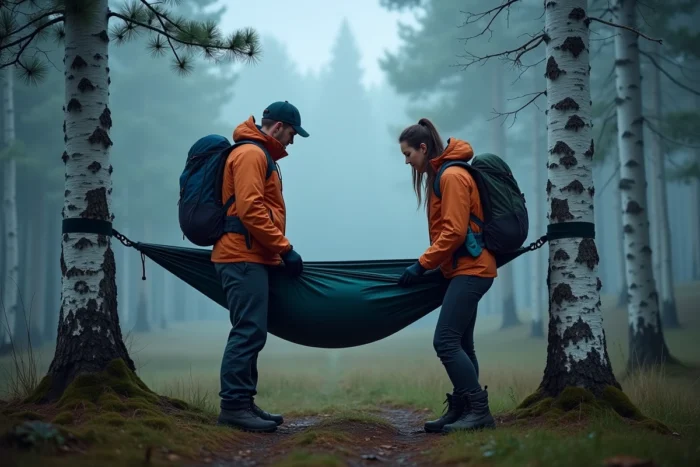
Bivouac equipment is not limited to a sleeping bag and a tent. Several often-overlooked elements directly affect safety and recovery.
- A sleeping bag suitable for the lowest expected temperature, not the average: the night is always colder than expected, especially at altitude or by the sea.
- A mattress with sufficient insulation for the season, tested before departure (a punctured mattress is difficult to detect at night).
- A headlamp with charged batteries for any nighttime intervention (movement, checking the environment).
- Sufficient water for the night and upon waking, especially in summer.
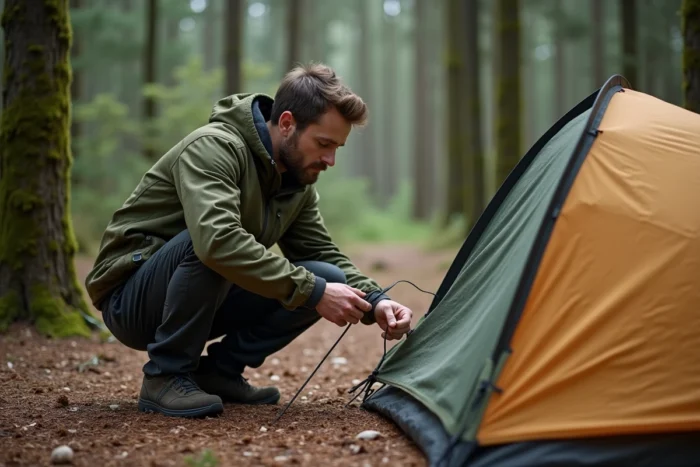
- A lightweight shelter (tarp, tarp, or tent) capable of protecting against an unexpected downpour, even if the weather forecast predicts good weather.
Testing your equipment in a safe setting (garden, near a shelter) before an isolated outing allows you to identify comfort flaws and equipment gaps without serious consequences.
Bivouac regulations vary by country, national parks, and municipalities. In France, the general rule allows bivouacking between sunset and sunrise, but many national parks impose specific restrictions. Checking local legislation before departure avoids fines and an unpleasant awakening.
A well-prepared night outside rests on three pillars: proper ground insulation, a methodically chosen location, and maintained hydration. The rest, including fear of the dark or unusual noises, diminishes with experience, provided that the fundamental safety principles are in place.