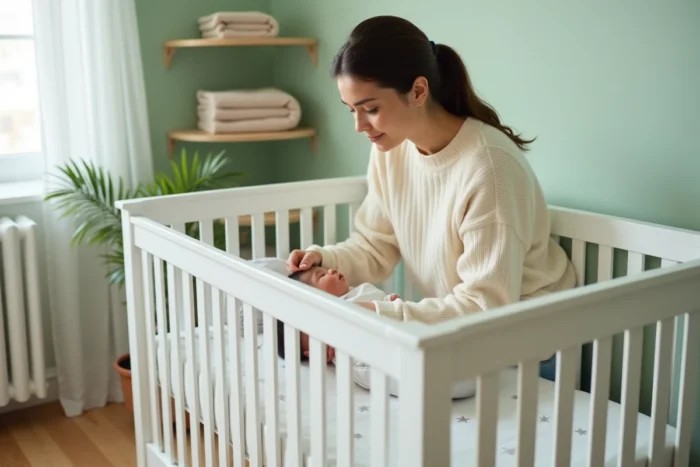
The choice of a baby bed is based on a technical trade-off between three variables: the available floor space in the sleeping room, the intended duration of use, and compliance with current safety standards. We recommend establishing these criteria before any aesthetic considerations, as a poorly sized bed can lead to either premature replacement or an unsuitable sleeping environment for the child’s morphology.
NF EN 1130 standard and wall height: what the labeling doesn’t always reveal
For cribs and co-sleeping beds, the NF EN 1130 standard requires a minimum wall height of 20 cm above the sleeping surface. This threshold may seem modest, but it conditions the actual usage window of the product. As soon as the infant starts to actively roll over, a compliant crib that is close to the regulatory minimum becomes practically insufficient.
We observe that several models marketed as “usable up to 9 months” reach their safety limit well before this deadline, simply because the wall height is close to the regulatory floor. Check the exact measurement on the technical sheet, not on the marketing packaging.
Additionally, a guide detailing the sizes of baby beds on Maman du Net allows for a quick comparison of common formats and their respective constraints.
Room sharing and bed format: an underestimated link
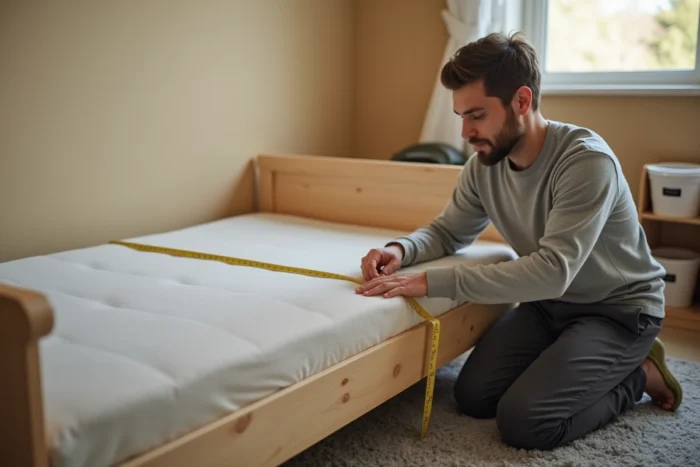
Current health recommendations advocate for room sharing without bed sharing for at least six months, ideally up to twelve months, to reduce the risk of sudden infant death syndrome. This duration directly modifies the size choice equation.
If the bed remains in the parental bedroom for a full year, a compact crib (approximately 40 x 80 cm) only covers one-third of this period. Therefore, a second sleeping arrangement must be planned, or one should opt right away for a mid-sized crib that can fit in a restricted space.
The 60 x 120 cm format fits in most parental bedrooms without obstructing movement. The 70 x 140 cm, being bulkier, often poses problems in rooms smaller than twelve square meters. We recommend measuring the free space between the parental bed and the wall before ordering.
60 x 120 cm baby bed vs. 70 x 140 cm: technical trade-off
The 60 x 120 cm remains the reference format for use from birth up to about two and a half years. Its reduced bulk and the generally lower cost of the associated mattress make it a rational choice when the room is small or when a separate child bed is already planned for later.
The 70 x 140 cm, often offered in an evolving version, extends use up to four or five years. The main advantage is the savings on an intermediate purchase, but this savings is only real if the bed’s structure can effectively support the removal of the bars and the conversion to an open sleeping arrangement without loss of rigidity.
Here are some technical criteria to check before choosing between these two formats:
- The mattress fit: no gap greater than two fingers between the edge of the mattress and the wall, around the entire perimeter. A mattress that is too small in a 70 x 140 frame creates a potential trap for the infant’s limbs.
- The adjustable height of the bed base: at least two positions are necessary. The high position facilitates laying down for a newborn, while the low position secures the bed as soon as the child stands up.
- The spacing of the bars: the normative range is between 4.5 and 6.5 cm. Below this, there is a risk of finger entrapment. Above this, there is a risk of head passage.
Density and thickness of the baby mattress: the forgotten parameter

Choosing the right bed size without considering the mattress is like sizing a frame without checking what will be placed on it. A baby mattress must be firm, not just thick. Confusing these two concepts leads to inappropriate purchases.
In polyurethane foam, too low a density results in rapid sagging in the center, where the infant’s weight concentrates. Natural latex offers better long-term resilience, but its weight makes changing sheets more cumbersome on a high crib.
Some concrete benchmarks for evaluation:
- Press the mattress in the center with your palm: if it doesn’t regain its shape in less than two seconds, the firmness is insufficient for an infant.
- Check that the cover is removable and washable at high temperatures. A mattress with a non-removable cover accumulates allergens without an effective cleaning solution.
- The ideal thickness for a baby mattress remains moderate. A mattress that is too thick reduces the useful height of the bars and may compromise the bed’s safety compliance.
Evolving bed: actual profitability depending on family configuration
The evolving bed appeals with its promise of longevity. In practice, its profitability depends on the age gap between children. If a second child arrives less than three years after the first, the evolving bed will likely be vacated before reaching its “child” phase, negating the expected savings.
The quality of the conversion hardware is another technical point often overlooked. Transformation kits (removal of bars, addition of low side panels) vary significantly from one manufacturer to another. A mechanism with visible screws or plastic clips weakens the structure over time with handling.
For a family planning for only one child and having a stable room for several years, the 70 x 140 evolving bed remains a relevant choice. For other configurations (likely moving, close siblings, shared room), the 60 x 120 followed by a dedicated child bed offers more flexibility.
Choosing a baby bed size is not a matter of trend or design. It is a calculation that intersects the room’s area, the expected duration of use, and the rigor of safety specifications. A well-chosen format from the start avoids untimely replacement and ensures safe sleeping throughout the intended usage period.