The word “douille” carries an etymological depth that most online dictionaries flatten into a few lines. Here, we start from the oldest layer, Gothic, to trace the contemporary slang usages and recent semantic shifts that public resources overlook.
Germanic etymology of “douille”: from Gothic to medieval French
The best-documented lineage connects the French “douille” to the Gothic *dulja, referring to a hollow piece for fitting. The Old High German tulli (a socket fitted to the tip of an arrow or spear) and the Middle High German tülle confirm this Germanic path. Modern German Tülle, which designates a spout or drainage pipe, retains the trace of this root.
In Old French, the form doelle appears around 1225 to name the hollow part of a tool receiving the handle. Doile follows around 1250, then douille becomes fixed around 1393. This trajectory shows a stable word over nearly two centuries, rooted in the technical vocabulary of craftsmen.
A competing hypothesis connects “douille” to the Latin ductile (gutter, water conduit), derived from ductilis (“easy to lead”). The link with “andouille,” stemming from the Vulgar Latin inductile, reinforces this Latin path. We observe that both lineages, Germanic and Latin, converge towards the same image: a hollow cylindrical container intended to receive an element. It is this morphological constant that explains the current polysemy of the term.
To delve deeper into the definition of douille in its slang sense, we must start from this physical meaning of an emptied envelope to understand how the word has shifted to the popular register.
Technical polysemy of the word douille: armament, electricity, pastry

The word douille today covers at least four distinct technical fields, each with its own standards and specification vocabulary.
- Armament: a cylindrical tube containing the primer and explosive charge of a cartridge. Bullet, shell, or anti-aircraft rocket casings share the principle of a brass base housing the percussion primer, but differ in caliber, material, and ejection method.
- Electricity: a piece of copper or brass receiving the base of a bulb and ensuring the connection to the power circuit. We distinguish between bayonet sockets (B22), screw sockets (E27, E14), and the so-called “thief” socket that allows for a remote connection. The compatibility of base and socket is governed by specific electrical safety standards.
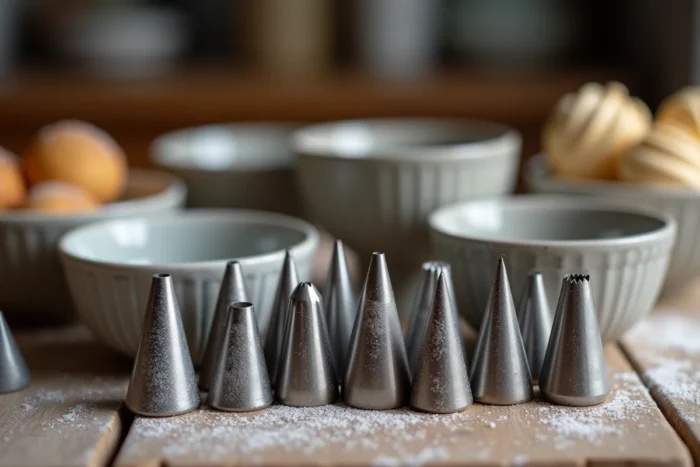
- Culinary art: a conical instrument suited to a cloth bag, shaping a ribbon of cream, meringue, or dough. The shape of the opening (star, round, leaf) determines the profile of the decoration.
- Mechanics: a hollow assembly piece serving as a sleeve between two elements, for example on a spade or a fitted tool. Metric and standard socket size charts (socket wrenches) constitute basic tools in automotive mechanics.
This semantic dispersion is not an accident. The common core remains the cylindrical cavity receiving another element, whether it is a bulb, a propulsive charge, or a tool handle.
Slang and expression “mettre une douille”: from Vidocq to Delvau
The shift to slang occurs through direct metaphor. “Douiller” means to pay, to incur an excessive cost. Alfred Delvau’s Dictionnaire de la langue verte and Lucien Rigaud’s surveys document this usage in the slang of the Parisian populace. Vidocq already uses the term in a register where douille becomes synonymous with money, likely by association with the metal piece that one “drops.”
“Mettre une douille” or “se faire douiller” refers to being scammed, paying an unreasonable price. The image works because the douille is an envelope emptied of its useful content: only the empty casing remains, just as only the lightened wallet remains.

The expression persists in contemporary French with notable vitality. It belongs to the familiar register without being vulgar, allowing it to circulate both orally and in writing, including in the press.
Derivatives and regional variants
The verb “douiller” is used alone (“j’ai douillé”) or in the phrase “ça douille” to indicate a high price. The word “andouille,” although sharing an etymological root, has followed a completely different semantic trajectory towards the idea of a fool or simpleton. The two terms no longer overlap in common usage.
Contemporary usages of “douille” in substance slang
A recent meaning, absent from classic dictionaries (Larousse, CNRTL, Le Robert), deserves attention. The expression “couler une douille” refers in cannabis-related slang to the act of consuming resin or herb via a metal piece inserted into a bong. The douille here becomes the physical accessory – a small container whose shape and screen influence combustion and draw.
This shift illustrates a classic mechanism: the technical term migrates to a social subgroup that adopts it to name a functionally similar object. Some sources even document the expression “couler une douille freebase” for the consumption of freebase cocaine, indicating that the word continues to branch out into specialized registers.
This semantic extension confirms that “douille” remains a productive word in French. Its short phonetic structure, its concrete image of a hollow container, and its long slang history give it a plasticity that few technical terms possess. The word traverses registers without losing its core meaning, from the medieval craftsman to the vocabulary of contemporary street language.