
Accompanying an infant during their first months of life involves distinguishing between strict safety and optional comfort. Recent French recommendations, particularly those from the HAS, redefine priorities: secure sleeping arrangements, prevention of domestic accidents, and immunization against bronchiolitis weigh more heavily than the choice of a developmental accessory. This article reviews concrete data to prioritize actions and equipment for the first months.
Secure sleeping arrangements for infants: what the HAS really recommends
Sleep concentrates the majority of serious risks for infants. Recent French recommendations emphasize a central point: a separate crib in the parents’ room for six months. The mattress must be firm, with no soft objects around the baby.
The list of items to remove from the crib is longer than many parents imagine. The HAS classifies certain support devices (baby wedges, positioning pillows) as unnecessary, or even dangerous. Neither pillows, blankets, nor bumper pads should be present in the sleeping space.
| Item | HAS Recommendation | Common Practice |
|---|---|---|
| Mattress | Firm, exact dimensions of the crib | Sometimes too soft or poorly fitted |
| Bumper pad | To be avoided | Still widely used |
| Baby wedge / positioning pillow | Classified as unnecessary or even dangerous | Sold as a safety accessory |
| Blanket / pillow | No soft objects in the crib | Present in many cribs |
| Sleeping place | Separate crib, parents’ room | Co-sleeping sometimes poorly managed |
The gap between official recommendations and common practices remains significant. Many products marketed as sleep aids directly contradict the HAS’s guidelines. Before purchasing a sleeping accessory, checking its compliance with these recommendations helps avoid unnecessary and potentially risky purchases.
To complete your equipment with products suitable for the first months, you can learn more about Bébés Avenue, which lists equipment dedicated to infants.

Prevention of domestic accidents in babies: beyond bath time
Classic safety advice focuses on bath time and diaper changes. Santé publique France broadens the scope: keeping a hand on the baby at all times when elevated is one of the priority actions, whether on a changing table, a sofa, or an adult bed.
Falls from elevated surfaces are among the most frequent accidents in infants. The reflex to step away “just for a second” to grab a diaper or clothing can lead to a tumble. The rule is simple: if the baby is elevated, one hand remains on them.
Santé publique France also recommends keeping furniture and objects away from open windows. This point applies to upper-floor housing, but not only: a low piece of furniture placed under a window becomes a stepping stool as soon as the child starts to move, sometimes earlier than expected.
- Changing table: all necessary items (diapers, water, cotton) should be within reach before placing the baby on it
- Windows: remove any furniture that allows a child to climb near an opening
- Elevated surfaces: never leave an infant without physical contact on an adult bed, sofa, or countertop
These precautions cost nothing and require no purchases. They rely on organizing the space and developing reflexes to implement as soon as you return from the maternity ward.
First car ride with baby: R129 standard and mandatory car seat
A certified restraint system is mandatory from birth, including for the very first trip from the maternity ward. The R129 standard, in effect in France, mandates rear-facing transport. This is not a recommendation: it is a legal obligation.
The car seat is one of the few pieces of equipment that must be prepared before childbirth. Unlike other accessories (bouncer, swing, play mat), it determines the very possibility of leaving the maternity ward by car.
However, not all seats on the market are equal in practical terms. Compatibility with the vehicle, the fastening system (Isofix or seatbelt), and the ergonomics of the shell for a newborn vary from model to model. Testing the installation in the car before birth helps avoid unpleasant surprises on the big day.
Protection against bronchiolitis: two immunization strategies to discuss
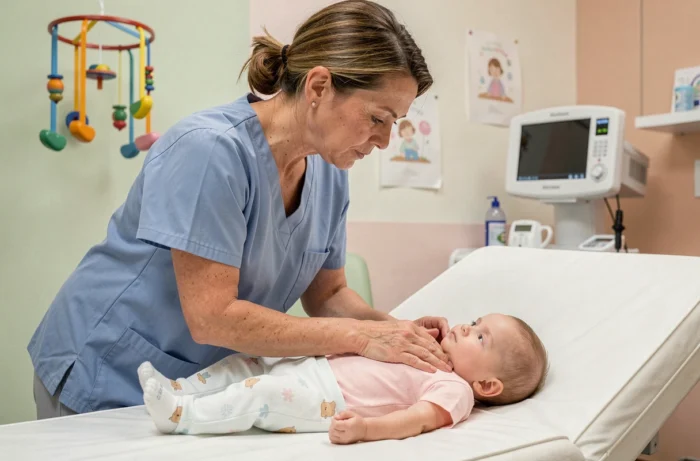
Bronchiolitis remains a major concern during the first months of life. Recent sources mention two distinct approaches: immunization of the infant with monoclonal antibodies and maternal vaccination during pregnancy.
The HAS does not express a general preference between these two options. The choice depends on the medical context of each family and should be discussed with a healthcare professional. This topic deserves to be addressed early, ideally before birth for the maternal vaccination strategy.
Daily care and hygiene for infants
Bathing, diaper changes, and skincare constitute the daily routine of the first months. An infant’s skin is thinner and more permeable than that of an adult, which justifies the use of hygiene products specifically formulated for babies. Scented products, wipes with complex compositions, and unsuitable creams can cause irritations.
For bathing, a frequency of two to three times a week is sufficient during the first weeks. Daily cleaning of the diaper area and skin folds complements this routine without harming the skin barrier.
Prioritizing the first months around safety (sleeping, accidents, transport) rather than equipment changes the approach to this period. A sleeping environment that complies with HAS recommendations and well-established prevention reflexes protect the infant more than a catalog of poorly chosen accessories.