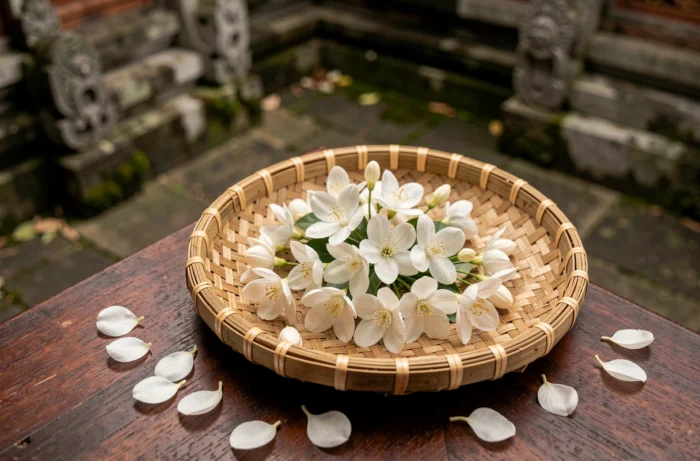
In Bali, the white jasmine that Indonesians call melati putih (Jasminum sambac) is not just a simple ornamental flower. It is the national flower of Indonesia, a central element of Balinese Hindu offerings, and a prized raw material in perfumery. Understanding its role is to grasp an entire aspect of the island’s culture.
Melati putih: national status and ritual role of jasmine in Bali
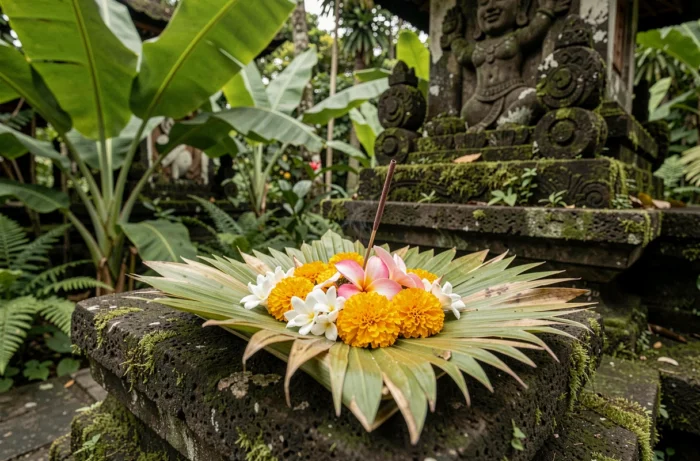
Have you ever noticed those small white crowns placed on altars along the Balinese roads? They are canang sari, the daily offerings of Balinese Hinduism. The white jasmine has a specific place in them.
In the Balinese ritual system, each flower corresponds to a cardinal direction and a deity. The white of jasmine is oriented towards the East, associated with the god Iswara. Thus, it is not an aesthetic choice: placing jasmine in an offering invokes a particular spiritual force.
This role extends beyond Bali. The melati putih is recognized as Indonesia’s national flower, alongside the frangipani (often confused with it in tourist content). Where the frangipani, called jepun, visually dominates gardens and temples, jasmine acts more discreetly, almost daily, in the ritual gestures of families. To delve deeper into the secrets of the Balinese flower, one must distinguish between these two plants that many confuse.
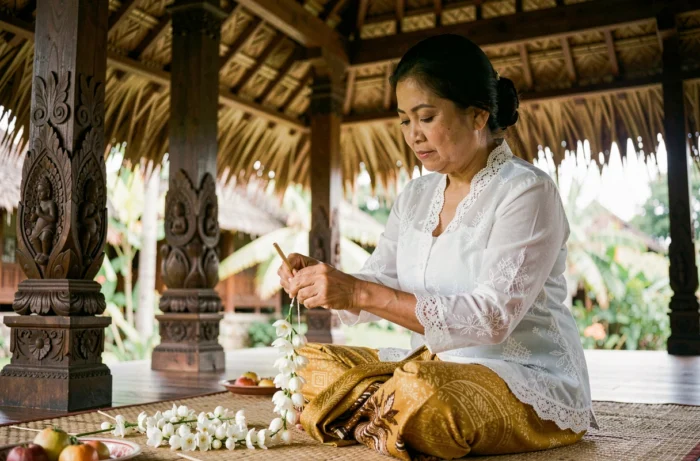
Jasmine and frangipani: two Balinese flowers not to be confused
The frangipani produces large, fleshy flowers in yellow and white, with a sweet fragrance. Jasmine sambac gives small white flowers with a more heady scent that intensifies at night. Both are white, both are used in offerings, but their uses diverge.
- The frangipani (jepun) is primarily decorative and symbolic in temples. Its cosmetic properties (hydration, softening) make it an ingredient in skin care
- Jasmine sambac is used in daily domestic rituals, in perfumery, and in infusions (with precautions, see below)
- In traditional Balinese cosmetics, jasmine is included in the composition of massage oil and some hair care products, while frangipani dominates facial care
Jasmine and frangipani do not serve the same functions in Balinese life. This difference is fundamental for anyone interested in the island’s traditions or wishing to bring back coherent local products.
Benefits of Balinese jasmine: between real benefits and precautions
Jasmine is often presented as a universally beneficial plant. Its actual uses deserve to be detailed precisely.
Recognized properties in aromatherapy and care
Jasmine essential oil is renowned for its soothing and relaxing effects. This is one of the reasons why spas in Ubud and tourist areas of Bali incorporate it into their massage oils. Its fragrance affects mood, and Balinese tradition has long associated it with relaxation and purification.
In skin care, jasmine is used for its softening properties. Balinese women sometimes incorporate it into homemade preparations, mixed with coconut oil or other local plants.
A point of caution often overlooked
Not all plants called “jasmine” are Jasminum sambac. Some species commonly referred to as jasmine are toxic if ingested. The false jasmine (Gelsemium) is the most well-known example. Before preparing an infusion or applying a handmade product to the skin, one must ensure the exact species used.
This botanical confusion is common. It affects both travelers buying products at Balinese markets and herbal enthusiasts ordering online without checking the species.
Jasmine in high perfumery: from Bali to luxury houses
Jasmine is not just a temple or spa flower. It is also one of the most expensive raw materials in global perfumery.
The jasmine absolute is increasingly recognized for its heritage and industrial value in certain producing regions. It is obtained through solvent extraction, a process that requires a considerable amount of flowers to produce just a few grams of concentrate.
In Bali, jasmine cultivation remains artisanal and oriented towards local needs (offerings, care, ceremonies). The island is not an industrial production hub like Grasse in France or certain Indian regions. Balinese jasmine derives its value from its cultural use, not from its production volume.
This distinction explains why jasmine-based products sold in Balinese spas do not compete in concentration with the absolutes used in fine perfumery. Their interest lies elsewhere: in the sensory experience related to the place, the massage, and the tradition.
Jasmine in Asian traditions: a symbol beyond Bali
Jasmine extends far beyond the Balinese context. In several cultures across Asia, the Middle East, and North Africa, it plays a role in weddings, religious rituals, and seduction practices. In Tunisia, the mechmoum (bouquet of jasmine) is a social and sentimental object. In India, jasmine garlands adorn women’s hair and the statues of deities.
In Bali, jasmine is part of a structured Hindu symbolic system where each natural element has a codified spiritual function. This ritual rigor distinguishes Balinese use from a simple decorative or fragrant gesture.
For travelers visiting the island, observing how jasmine is handled in daily offerings provides a direct key to understanding Balinese spirituality. It is not a folklore reconstituted for tourists: canang sari are placed every morning, in every home, with a regularity that is far from staged.